
C# 14 (shipping with .NET 10) is not a paradigm-shifting release. It’s a refinement release: a set of focused changes that remove long-standing boilerplate and close gaps that forced you into workarounds. Two of them change how you write members, and they’re the ones you’ll reach for daily.
The field keyword: the missing middle of properties
For twenty years, C# properties had exactly two states and nothing in between. The auto-property, concise and logic-free:
public string Name { get; set; } // compiler generates a hidden backing field, but you can't touch it
And the full property, the moment you needed any logic — validation, change notification, lazy init — which meant hand-declaring a backing field and both accessors:
private string _name;                                  // boilerplate
public string Name
{
    get => _name;
    set => _name = value ?? throw new ArgumentNullException(nameof(value));
}
That gap was pure friction. In roughly 95% of cases the manual field did nothing interesting, and — worse — that _name field was now visible to the rest of the class, so any method could bypass your validation by writing to it directly.
C# 14 introduces the field contextual keyword, which refers to the compiler-synthesized backing field from inside a property accessor. The middle state finally exists — the “semi-auto property”:
public string Name
{
    get => field;                                      // 'field' is the generated backing store
    set => field = value ?? throw new ArgumentNullException(nameof(value));
}

// you can also implement just ONE accessor and let the compiler generate the other:
public int Age
{
    get;                                               // compiler-generated getter
    set => field = value >= 0 ? value : throw new ArgumentOutOfRangeException(nameof(value));
}

Three things make this more than sugar. It eliminates the boilerplate field declaration. It preserves encapsulation — the backing store is reachable only through the accessors, so validation can’t be bypassed elsewhere in the class. And it’s the natural fit for the two most common property-logic scenarios: validation (as above) and change notification in MVVM view models:
public string Title
{
    get => field;
    set { field = value; OnPropertyChanged(); }        // raise INotifyPropertyChanged, no manual field
}
Two facts to file away. field is a contextual keyword — it only has special meaning inside a property or indexer accessor, so existing code compiles unchanged. But that creates the release’s most-cited breaking change: if you already have a symbol named field in scope, inside an accessor it now resolves to the backing field, not your symbol. The fix is to disambiguate with @field or this.field, or simply rename the symbol — and the pragmatic advice is to avoid naming anything field. (This feature shipped as a C# 13 preview behind LangVersion=preview; C# 14 makes it official.)
Extension members: beyond extension methods
Extension methods have been a cornerstone since C# 3, but they were always just methods — and always instance-style. You could not write an extension property, an extension operator, or a static extension. Want an IsEmpty that reads like a property on IEnumerable<T>? You were stuck writing IsEmpty(this IEnumerable<T> source) and calling it as a method. C# 14’s extension members remove that ceiling.
The new syntax is the extension block — you declare the receiver once on the block, and everything inside extends it:
public static class EnumerableExtensions
{
    // instance-style: receiver has a name, members act like instance members of IEnumerable<T>
    extension<T>(IEnumerable<T> source)
    {
        public bool IsEmpty => !source.Any();                              // extension PROPERTY
        public T FirstOr(T fallback) => source.FirstOrDefault() ?? fallback; // extension method
    }

    // static-style: receiver is a type only (no name) — members act like static members of the type
    extension<T>(IEnumerable<T>)
    {
        public static IEnumerable<T> Empty() => [];                       // static extension method
    }
}

// used exactly like real members:
bool empty = numbers.IsEmpty;                 // reads like an instance property
var xs = IEnumerable<int>.Empty();            // reads like a static method on the type
The receiver form is the key distinction: extension<T>(IEnumerable<T> source) — a named receiver — produces members that behave like instance members; extension<T>(IEnumerable<T>) — a type-only receiver — produces members that behave like static members of the type. You can even declare extension operators, letting you add + or - to a type you don’t own.

Because the user’s interest is extending interfaces: yes — this works, and it’s one of the most useful cases. The IEnumerable<T> examples above are interface extensions. You can add methods, properties, and operators to any interface you don’t control, which previously required either awkward method-only extensions or wrapper types.
One precise correction worth making, since it’s easy to over-claim: C# 14 extension members cover methods, properties, and operators — instance and static. They do not yet support events, fields, indexers, nested types, or constructors; those are acknowledged as future work. (If you’ve seen “extension events” mentioned, it’s likely a conflation with C# 14’s separate partial events feature — a code-generation aid covered later — which is unrelated to extensions.) Two more rules matter: extension members only fill gaps — they never override or shadow a real instance member, and are considered only when no instance member matches — and the classic this-parameter syntax still works and coexists with blocks, so you don’t have to convert anything. The one breaking change: extension is now a contextual keyword, so a type or alias named extension must be renamed (error CS9306).
Generics, Resolution, and Expression Polish
Where previous features changed how you declare members, the next features change how the compiler resolves and how you express everyday operations. Several are small; one — overload resolution — is subtle enough to bite you, so it gets the most attention.
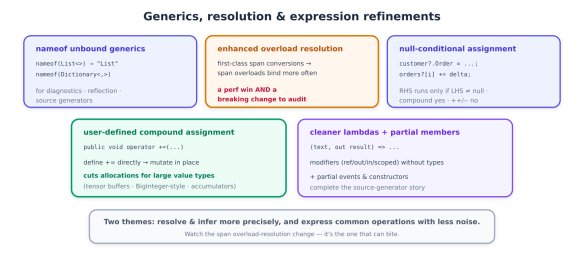
nameof for unbound generics
A small, welcome fix. Before C# 14, nameof required a closed generic type — you had to invent a placeholder type argument just to get a name:
// before: you had to supply a throwaway type argument
string n = nameof(List<int>);          // "List"  — but why should you need <int>?
C# 14 lets nameof accept an unbound generic type, so you write what you mean:
string list = nameof(List<>);          // "List"
string dict = nameof(Dictionary<,>);   // "Dictionary"
It returns the name of the generic type definition — no type arguments required. This is squarely aimed at logging, diagnostics, reflection, source generators, and analyzers, where you want a type’s name without caring about (or having) its type parameters. It’s minor, but it removes a papercut that showed up constantly in framework and tooling code.
Enhanced overload resolution: a feature and a trap
This is the one to read carefully. C# 14 introduces first-class support for Span<T> and ReadOnlySpan<T> — new implicit conversions between T[], Span<T>, and ReadOnlySpan<T>, plus the ability for spans to act as extension receivers and participate in generic inference. The everyday benefit is real: array-to-span code just works, with fewer explicit .AsSpan() calls:
void ProcessSpan(ReadOnlySpan<int> data) { /* ... */ }

int[] array = [1, 2, 3];
ProcessSpan(array);                     // implicit T[] → ReadOnlySpan<T>, no .AsSpan()

ReadOnlySpan<char> chars = "hello";     // implicit string → ReadOnlySpan<char>
But making span overloads applicable in more scenarios means the compiler now sometimes picks a different overload than it did in C# 13 — and that is a genuine, documented behavioral breaking change, not a footnote. The canonical example: in C# 13, an extension method taking a Span<T> receiver did not apply to a T[], so calls on arrays bound to the System.Linq.Enumerable (IEnumerable<T>) overloads. In C# 14, the span-based System.MemoryExtensions overloads become applicable — and win.
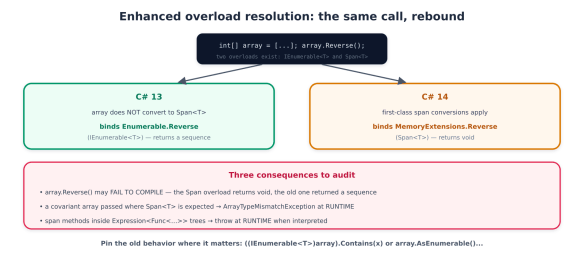
The concrete ways this surfaces are worth memorizing, because some fail loudly and some fail silently at runtime:
// 1. Compile break: the Span<T> overload returns void, the Enumerable one returned a sequence
_ = strings.Reverse();                  // C#13: Enumerable.Reverse (IEnumerable<T>); C#14: MemoryExtensions.Reverse (void) → error

// 2. Runtime throw: a covariant array can't convert to Span<object>
void M(object[] arr) => Util.Do(arr);   // C#14 binds Span<T> overload → ArrayTypeMismatchException at runtime

// 3. Pin the old behavior explicitly when you need it:
_ = ((IEnumerable<int>)array).Contains(x);   // force the Enumerable overload
_ = array.AsEnumerable().Contains(x);         // same, more readable
And the nastiest case: span-based methods now bind inside Expression<Func<...>> lambdas, where they compile fine but throw at runtime when the expression is interpreted rather than compiled. If you build LINQ expression trees (ORMs, query providers), audit them. The practical guidance: after upgrading, review span-heavy code and expression trees, lean on analyzer/ReSharper inspections that flag the change, and pin the old binding with an explicit IEnumerable<T> cast where behavior matters. This is the price of the performance win — worth it, but not free.
Null-conditional assignment
A clean ergonomic win. The null-conditional operators ?. and ?[] can now appear on the left side of an assignment or compound assignment — the mirror of the null-conditional read you already use:
// before
if (customer is not null)
    customer.Order = GetCurrentOrder();

// C# 14
customer?.Order = GetCurrentOrder();    // assigns only if customer != null; RHS evaluated only then
orders?[i] += delta;                    // compound assignment works too
The right-hand side is evaluated only when the left side is non-null — so GetCurrentOrder() isn’t even called if customer is null, which matters when the RHS has side effects. One restriction: this works with assignment and compound operators (+=, -=, …) but not with increment/decrement (++, --).
User-defined compound assignment operators
Previously, x += y on your own type always meant x = x + y — the compiler synthesized the compound form from your binary + operator, allocating a new instance every time. For large value types that’s wasteful. C# 14 lets you define the compound operator directly, as an instance operator that mutates the receiver in place:
public struct BigAccumulator
{
    private long[] _buffer;
    // user-defined += : mutates in place instead of allocating a new BigAccumulator
    public void operator +=(BigAccumulator other)
    {
        for (int i = 0; i < _buffer.Length; i++)
            _buffer[i] += other._buffer[i];     // no new allocation
    }
}
The payoff is allocation reduction for big value holders — think tensor buffers, BigInteger-style number types, or accumulators in a tight loop, where the old copy-on-+= behavior was pure GC pressure. This connects directly the allocation-free theme (and to the green-coding series’ point that efficient code is cheaper and greener). C# 14 also allows user-defined ++ and --.
Cleaner lambda parameters
Finally, a syntax polish: lambda parameters can now carry modifiers — ref, in, out, ref readonly, scoped — without forcing you to write the parameter types:
// before: modifiers required explicit types
TryParse<int> parse = (string text, out int result) => int.TryParse(text, out result);

// C# 14: modifiers with inferred types
TryParse<int> parse = (text, out result) => int.TryParse(text, out result);
One breaking change rides along: scoped is now a reserved word in lambda parameter position, so an identifier named scoped needs @scoped.
A related code-generation feature completes the picture: partial events and partial constructors. C# 13 made properties and indexers partial; C# 14 finishes the set, so a source generator can supply the implementation of an event or constructor whose declaration you wrote by hand — the same separation-of-definition-and-implementation pattern that makes generated code clean.
A recurring goal across recent C# versions is letting you write allocation-free code — code that keeps data on the stack, avoids heap churn, and so avoids the garbage-collection pressure that shows up as latency spikes and, per the green-coding series in this library, as wasted cost and energy. C# 14 advances that goal on several fronts. But it does so on top of work that landed in C# 13, and a deep dive should be precise about which is which — so let’s draw that line clearly.
Setting the record straight: ref struct interfaces are C# 13
The headline “ref struct interfaces” capability — the ability for a ref struct (a stack-only type like Span<T>) to implement an interface, and the allows ref struct anti-constraint that lets a ref struct be used as a generic type argument — arrived in C# 13, not C# 14. It’s foundational to the allocation-free story, so it belongs in this discussion, but calling it new in C# 14 would be wrong.
Here’s what C# 13 unlocked, because C# 14’s features build directly on it:
// C# 13: a ref struct can implement an interface
public interface IProcessor { void Process(); }

public ref struct SpanProcessor : IProcessor      // stack-only type, now polymorphic
{
    private readonly ReadOnlySpan<byte> _data;
    public SpanProcessor(ReadOnlySpan<byte> data) => _data = data;
    public void Process() { /* work over _data without copying to the heap */ }
}

// C# 13: 'allows ref struct' lets a ref struct be a generic type argument
public static void Run<T>(T proc) where T : IProcessor, allows ref struct
{
    proc.Process();                                // no boxing, no heap allocation
}
The significance: before this, a ref struct couldn’t participate in generic or interface-based polymorphism at all — you had to abandon stack-only types or abandon abstraction. Now you can write generic, abstracted, allocation-free code over Span<T> and your own ref structs. Note the crucial constraint that keeps it safe: a ref struct implementing an interface still cannot be boxed — you can only use it through a generic parameter constrained with allows ref struct, never as the interface type directly (that would require a heap allocation, defeating the purpose).
What C# 14 actually adds to the allocation-free toolkit
C# 14’s contribution is to make the surrounding code allocation-free and natural, and there are three pieces, each seen earlier in the series and now viewed through the performance lens.
First-class span conversions. The implicit T[] → Span<T>/ReadOnlySpan<T> and string → ReadOnlySpan<char> conversions from earlier aren’t just ergonomics — they let you thread arrays and strings through span-based APIs without intermediate copies or allocations, and let spans act as extension receivers and inference targets. That’s the connective tissue that makes ref-struct/span code read like ordinary code.
In-place user-defined compound assignment. The operator += from earlier that mutates the receiver instead of allocating a new instance is, fundamentally, an allocation-reduction feature — it turns a hot-loop sum += v over a large value type from N allocations into zero.
Overload resolution that prefers spans. The (breaking) resolution change from above means span-based library methods now bind by default in more places — so your existing code often gets more allocation-free without you rewriting it, which is exactly why the breaking change is worth tolerating.
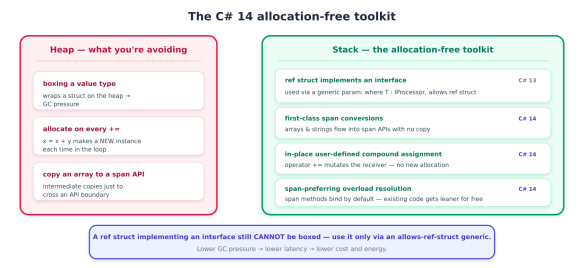
Put together, a modern allocation-free pattern looks like this — stack-only data, interface abstraction, generic dispatch, no heap:
ReadOnlySpan<byte> payload = GetBuffer();          // no copy
var processor = new SpanProcessor(payload);        // ref struct on the stack
Run(processor);                                    // generic dispatch via allows ref struct — zero allocations
The honest limits
C# 14 is a strong release, but a deep dive owes you the edges — and there are several worth planning around.
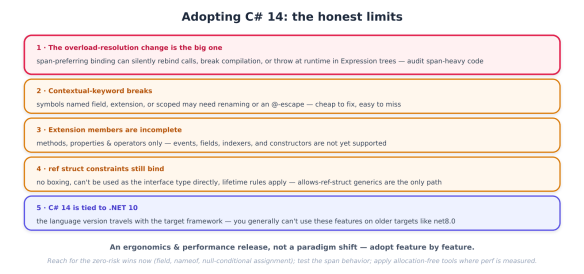
- The overload-resolution change is the real risk. As previously detailed, span-preferring binding can silently rebind calls, break compilation where return types differ, throw
ArrayTypeMismatchExceptionon covariant arrays, and — worst — throw at runtime inside interpreted Expression trees. This is the one thing to actively test after upgrading; the rest of C# 14 is additive. - Contextual-keyword breaks.
field,extension, andscopedall became contextual/reserved in their positions. Existing symbols with those names need@-escaping or renaming. Cheap to fix, easy to miss. - Extension members are incomplete. Methods, properties, and operators only. Events, fields, indexers, nested types, and constructors are not supported yet — so don’t design an API assuming extension events exist (they don’t; that’s the separate partial events feature).
ref structconstraints still apply. Implementing an interface doesn’t make a ref struct heap-friendly: no boxing, no using it as the interface type, and the usual lifetime/scopedrules. Theallows ref structgeneric path is the only way to abstract over them.- C# 14 is tied to .NET 10. The language version travels with the target framework, so you generally can’t sprinkle C# 14 features onto a project still targeting
net8.0. In practice, adopting C# 14 means adopting .NET 10 — which, per the previous series, is a forced move this year anyway.
The adoption playbook
- Adopt .NET 10 first — C# 14 rides with it, and the November 2026 support cliff (previous series) already forces that move.
- Turn on the analyzers. Let Roslyn and your IDE flag the span overload-resolution change; treat those inspections as a migration checklist, not noise.
- Audit span-heavy code and Expression trees specifically — this is where the behavioral break hides. Pin the old binding with
IEnumerable<T>casts where behavior matters. - Escape or rename any
field,extension, orscopedidentifiers. - Reach for the ergonomic wins immediately —
fieldin properties,nameof(List<>), null-conditional assignment — they’re zero-risk and cut boilerplate today. - Introduce extension members where they read better than method-only helpers (extension properties on interfaces especially), staying inside the methods/properties/operators boundary.
- Apply the allocation-free tools where they pay — in-place compound assignment and span APIs in hot paths and high-throughput services; don’t micro-optimize cold code.