
A lot of my posts are about how to build with AI — agents, orchestration, the Microsoft stack, the protocols. This series steps up a level and asks a harder question aimed squarely at senior and lead developers: in mid-2026, what actually makes you valuable? Because the answer has moved, and a lot of people haven’t noticed.
The bar is no longer “I integrated an LLM”
Two years ago, wiring an LLM into a product was a differentiator. You could stand up in a review, show a feature that called a model, and that was the value. In mid-2026 that’s table stakes — the equivalent of “I can call a REST API.” Every developer can integrate an LLM; the frameworks are mature, the SDKs are one import, and an agent scaffold is a template. Demonstrating that you can do it proves nothing any more.
The value bar for a senior or lead has shifted to something that was always the actual job: solving the problems that eat your week. Not “look what the model can do,” but “look what the team can now do that it couldn’t before.” And the problems that eat a lead’s week are stubbornly consistent.
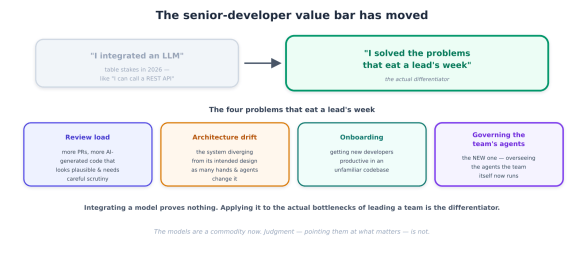
Review load. The volume of code a lead must review has gone up, not down, in the agent era — more pull requests, more AI-generated code that looks plausible and needs careful scrutiny, more surface area per change. The AI-slop-and-review piece in this library warned about exactly this.
Architecture drift. Systems diverge from their intended design as many hands — and now many agents — change them. Every shortcut, every “I’ll fix it later,” every agent that solved a local problem without understanding the global structure pulls the system away from its architecture. Catching that drift early is senior work.
Onboarding. Getting a new developer productive in an unfamiliar codebase is slow, expensive, and mostly falls on the leads who can least afford the time. The knowledge lives in people’s heads and scattered docs.
Governing the team’s own AI agents. This one is new. Your team now runs agents — for review, for ops, for data, for customer-facing features. Someone has to know which agents exist, what they can access, whether they still work, and whether they’re safe. That someone is you, and most teams have no answer yet.
The thesis of this series is simple: the senior developers winning in 2026 are the ones pointing AI at these four problems — not the ones with the flashiest demo. Below we cover the foundation that makes it buildable; A bit ahead, we’ll cover the shape and the discipline.
The protocol stack has solidified — build on it
Here’s the good news that changes the calculus: the interoperability layer stopped being a mess. Through 2025 there was a cacophony of competing proposals for how agents talk to tools, to each other, and to users. In 2026 that consolidated into a clear three-layer stack, and — critically — the layers are now under neutral, community governance, so building on them is a safe bet rather than a vendor lock-in gamble.
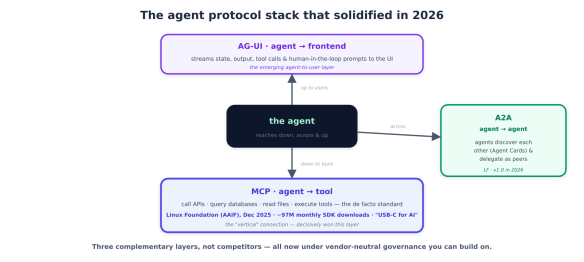
MCP (Model Context Protocol) is the agent-to-tool layer — the “vertical” connection by which an agent reaches down to call an API, query a database, read a file, or run a tool. It has decisively won this layer: it’s the de facto standard, with roughly 97 million monthly SDK downloads, thousands of public servers, and native support across Claude, ChatGPT, Gemini, Copilot, and Cursor. Most importantly for a lead making a bet, Anthropic donated MCP to the Agentic AI Foundation under the Linux Foundation in December 2025 — co-founded with Block and OpenAI, with AWS, Google, Microsoft, and GitHub joining — so it’s now a vendor-neutral standard governed by community process. It’s earned the nickname “the USB-C of AI.” The MCP-versus-A2A piece in this library called this early; it’s now settled.
A2A (Agent-to-Agent) is the agent-to-agent layer — the “horizontal” connection by which agents from different frameworks and vendors discover each other (via Agent Cards) and delegate tasks as peers. Google released it, and it too became a Linux Foundation project, reaching v1.0 in 2026 with broad enterprise backing. MCP and A2A are complementary, not competing — an agent uses MCP to reach its tools and A2A to coordinate with other agents, and serious systems use both.
AG-UI is the newest layer — agent-to-frontend — standardising how an agent streams its state, output, tool calls, and human-in-the-loop prompts to a user interface. It’s the piece that turns an agent from a backend process into something a user actually interacts with, and it completes the stack: down to tools, across to agents, up to users.
The Agent Harness
Once you accept that the job is solving the four problems, the next question is architectural: what shape does a system that helps take? The answer that has consolidated across serious deployments is the agent harness — and it looks nothing like the single-mega-prompt most people reach for first.
The shape: an orchestrator coordinating specialised sub-agents
The pattern is an orchestrator that coordinates specialised sub-agents, often working in parallel. Instead of one agent with an enormous prompt trying to do everything, you have a coordinator that decomposes a task, dispatches focused sub-agents each responsible for one thing, and integrates their results. The multi-agent-orchestration piece in this library described the patterns; the harness is what they look like when they’re load-bearing.
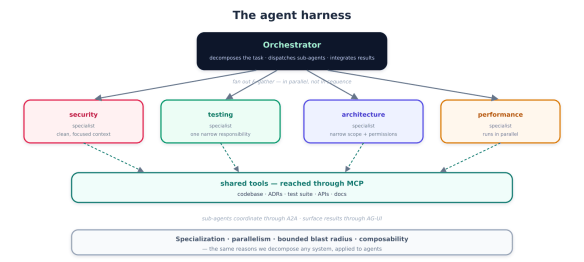
Why this shape wins over one big agent comes down to four properties, each of which a senior developer will recognise as the same reasons we decompose any system:
- Specialisation. A sub-agent responsible for one thing — checking security, say — gets a clean, focused context and clear instructions, and does that one thing far better than a generalist juggling ten concerns in a single bloated prompt. This is the context-engineering discipline applied to agents: narrow context, better output.
- Parallelism. Independent sub-agents run at the same time, so a task that would take a single agent ten sequential steps finishes in the time of the slowest one. For a lead waiting on a review, that’s the difference between useful and ignored.
- Bounded blast radius. Each sub-agent has a narrow scope and narrow permissions, so when one misbehaves — and they do — the damage is contained. This is the least-privilege instinct from the agent-security pieces, made structural.
- Composability. Add a new specialist without rewriting the whole system; the orchestrator gains a capability the way a team gains a hire.
And this is exactly where the previous protocol stack pays off: sub-agents reach their tools through MCP, coordinate with each other through A2A, and surface their work to you through AG-UI. The harness is the structure; the protocols are the wiring.
Pointing the harness at the lead’s problems
The shape is only interesting if it solves the four problems. Three of them map onto a harness cleanly.
Review load. This is the canonical fit. A single “review this PR” agent produces shallow, generic feedback. A review harness fans the pull request out to specialists in parallel — one checking security, one checking test coverage and quality, one checking adherence to your architecture and conventions, one checking performance — and the orchestrator aggregates their findings into a single prioritised review that distinguishes “this is a security hole” from “this is a nit.”

The crucial detail, straight from the plan-execute-verify discipline: the harness proposes, the human disposes. The review lands on your desk pre-triaged, so you spend your attention on the judgement calls instead of the mechanical scan — but you still make the call. It reduces review load, it doesn’t remove review responsibility.
Architecture drift. Point a harness at the gap between intended and actual design. One sub-agent extracts the intended architecture from your ADRs and design docs; another analyses what the code actually does; the orchestrator reports the delta — “this PR introduces a direct database call from the presentation layer, which your ADR-014 forbids.” Drift caught at the PR, when it’s cheap to fix, instead of six months later when it’s a rewrite. This is the kind of continuous architectural vigilance no lead has time to do manually across a large team.
Onboarding. A newcomer’s endless “how does X work here?” is a retrieval problem grounded in your specific codebase, docs, and history. An onboarding harness — sub-agents that search the code via MCP, read the docs, trace the git history, and explain — turns a week of interrupting senior developers into a self-serve pairing partner that answers in your codebase’s actual terms. It doesn’t replace mentorship; it absorbs the mechanical questions so mentorship can be about the things that actually need a human.
The senior judgement is in the decomposition
Here’s the part that stays a senior skill: deciding how to decompose the problem into specialists, and where the human belongs in the loop. The harness pattern is easy to draw and hard to get right — too many sub-agents and you’ve built a coordination nightmare with runaway cost; too few and you’re back to a generalist. Which specialists, what each one’s scope is, where they hand off, and which decisions require a human are architecture decisions, and making them well is exactly the senior value this series is about. The pattern is a tool; the judgement in wielding it is the job.
The differentiator isn’t more agents. It’s fewer, measured, guarded, shipped.
Here’s the shift that has quietly become the whole game. Through 2025, teams competed on quantity — who had the most agents, the biggest fleet, the most ambitious autonomous system. In 2026 the pattern among teams actually delivering value is the opposite: they instrumented a few high-value workflows with evaluation and guardrails, and shipped them. Not fifty agents; three that work, that they can measure, that they trust in production. The failures were almost never “the model wasn’t smart enough” and almost always “we couldn’t tell if it was working and we couldn’t keep it safe.”
So the senior move in 2026 isn’t building more. It’s picking the two or three workflows where an agent genuinely helps, wrapping them in the discipline that makes them dependable, and putting them in front of real users. Two disciplines make that possible.
Evaluation: you can’t ship what you can’t measure
Evaluation is the practice of measuring whether your agent actually works — systematically, repeatably, not by vibes. It’s the single biggest thing separating a demo from a production workflow, and the thing most teams skip because it’s less fun than building.
Concretely, evaluation means a golden dataset of representative inputs with known-good outcomes; task-success metrics that define what “correct” means for your workflow (did the review catch the real bug? did the answer cite the right file?); LLM-as-judge scoring for the outputs that can’t be checked mechanically; and regression testing so a model upgrade or prompt change that quietly makes things worse gets caught before your users find it. You run it offline against the golden set as you build, and online against real traffic once you ship. Without evaluation you’re flying blind — you literally cannot answer “is this better than last week?”, which means you cannot improve it and shouldn’t trust it.
Guardrails: the safety envelope that lets you ship
Guardrails are the constraints that keep an agent inside safe, intended behavior — the reason you can put it in production without lying awake. They operate at every edge of the agent: scope limits (least privilege — an MCP tool allow-list, not “here’s everything”), output validation (checking the agent’s output is well-formed and in-bounds before it acts), cost and token budgets (a runaway agent loop is a runaway bill, the green-coding piece’s point made operational), human-in-the-loop approval gates for consequential actions, and content and safety filters. Guardrails are what turn “impressive but terrifying” into “shippable.”

Governing your team’s agents: the discipline turned inward
Now the fourth problem from above — governing the team’s own AI agents — and here’s the insight that ties the series together: governance is the same instrument-and-ship discipline applied to your own fleet. The agents your team runs are themselves high-value workflows that need evaluation, guardrails, and one thing more: accountability.
A lead governing a team’s agents needs answers to five questions, and they map exactly onto what we’ve built: an inventory (which agents exist — most teams genuinely don’t know); an identity for each (its own scoped credential, not a shared key — this is precisely the Entra Agent ID and managed-identity story from the passwordless series, one agent, one identity, least privilege); evaluation (are they still working, or did a model update silently degrade them?); guardrails (what can each actually access and do?); and an audit trail (who — which agent — did what, when?). An agent without an owner, an identity, an eval, and an audit log isn’t an asset; it’s a liability with API access. Governing the fleet is how you keep the leverage without the risk — and in 2026, it’s a core part of the senior job that didn’t exist two years ago.
The honest limits
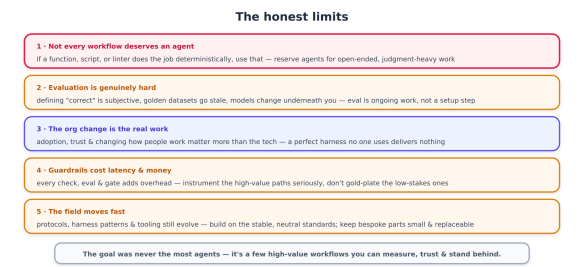
- Not every workflow deserves an agent. If a function, a script, or a linter does the job deterministically, use that — it’s cheaper, faster, and more reliable. Reserve agents for genuinely open-ended, judgement-heavy work. This is the plan-execute-verify discipline: the most agentic solution is rarely the best one.
- Evaluation is genuinely hard. Defining “correct” is often subjective, golden datasets drift out of date, and the models change underneath you. Eval is ongoing work, not a setup step — budget for it as a permanent cost, not a phase.
- The org change is the real work. Adoption, trust, and changing how people work matter more than the technology. A perfect review harness that developers route around delivers nothing. The senior skill includes bringing the team along.
- Guardrails cost latency and money. Every validation, every eval, every approval gate adds overhead. Instrument the high-value paths seriously and don’t gold-plate the low-stakes ones — match the rigour to the stakes.
- The field moves fast. Protocols, harness patterns, and tooling are still evolving. Mitigate by building on the stable, neutral parts (the Linux Foundation protocol stack) and keeping your bespoke logic small and replaceable.
The playbook
- Reframe your own value — stop demoing LLM integrations; start solving review load, architecture drift, onboarding, and agent governance.
- Build on the protocol stack — MCP for tools, A2A for coordination, AG-UI for surfacing — not bespoke glue.
- Use the harness shape — an orchestrator with a few specialised sub-agents — and put the senior judgement into the decomposition.
- Pick two or three high-value workflows. Resist the urge to build a fleet. Fewer, better, shipped.
- Instrument before you ship — a golden dataset, success metrics, and regression tests, plus scope limits, budgets, and human gates.
- Keep the human in the loop on consequential actions — the harness proposes, the human disposes.
- Govern your fleet — inventory, per-agent identity, eval, guardrails, audit. An ungoverned agent is a liability.
- Measure, then iterate — real traffic feeds the next round of evaluation; improve what you can now prove.
The whole picture
The bottom line for a senior or lead in 2026: the bar isn’t the model — everyone has the model. The bar is whether you can point it at the problems that actually matter, shape it into something dependable, and stand behind it in production. That’s the job it always was; the tools just changed.