
An ungrounded agent is a confident liar. Ask it about your company’s refund policy, last quarter’s numbers, or a customer’s order history, and it will produce a fluent, plausible, well-structured answer — drawn from its training data, its priors, or nothing at all. The words are right; the facts may be invented. That’s the hallucination problem, and it’s the single biggest barrier between a demo and a system you’d let talk to customers.
Retrieval-Augmented Generation (RAG) is the answer the industry converged on, and in 2026 it’s the default architecture for any agent that needs to answer from private or current data. The idea is simple: instead of hoping the knowledge is baked into the model’s weights, you retrieve the relevant facts at query time and hand them to the model as context, so its answer is grounded in real, citable documents.
RAG earns its place over the alternative — fine-tuning — for most knowledge tasks because your knowledge changes. Fine-tuning bakes information into weights: expensive, slow, and stale the moment a policy updates. RAG reads from a source you can edit in seconds. The rule of thumb: use RAG when your data changes, you need citations, or you face diverse queries; reach for fine-tuning when you need a consistent style, format, or domain-specific reasoning. Knowledge-grounding is squarely RAG’s job.
The anatomy of a RAG pipeline
Every RAG system has two halves: an offline ingestion path that prepares your knowledge, and an online query path that answers questions against it.

- Ingestion: split documents into chunks, convert each chunk into an embedding (a vector capturing its meaning), and store those vectors — with metadata — in a vector database.
- Query: embed the user’s question, retrieve the most similar chunks, optionally rerank them, and pass the best ones to the LLM, which generates an answer grounded in (and ideally citing) those chunks.
That’s the whole concept. As a wise practitioner put it: the concept is simple, the execution is not. And the execution problem has a specific location.
The uncomfortable truth: retrieval is the bottleneck, not the model
Here is the most important thing to internalise before you build anything. In 2026, RAG systems don’t usually fail because the model isn’t smart enough to write a good answer. They fail because the model was handed the wrong documents. The generation step is largely solved; the retrieval step is where quality leaks out.
The numbers are sobering. A naive RAG pipeline — the kind you build in a weekend tutorial — fails at retrieval roughly 40% of the time, and the failure is the dangerous kind: the LLM produces a confident, fluent, well-structured answer grounded in the wrong chunks. Naive retrieval plateaus around 70–80% precision for anything beyond simple factual lookups. If retrieval hands over irrelevant context, no model on earth can save the answer — garbage in, confident garbage out.
This connects directly to the “AI slop” problem: an answer that looks correct but isn’t. In RAG, the root cause is almost always retrieval, and that’s where your engineering effort belongs.
The maturity ladder: naive → advanced → agentic → adaptive
RAG has evolved well past the weekend-tutorial pattern. There’s a clear ladder of sophistication, each rung buying more accuracy at more cost and complexity.

- Naive RAG —
query → embed → top-k vector search → stuff into prompt → generate. The 2023 pattern. Fine for simple questions over a clean knowledge base; plateaus at 70–80% precision and fails ~40% of the time on harder queries. If a tutorial stops here, it’s out of date. - Advanced RAG — adds hybrid search (semantic + keyword), a reranker to sort retrieved chunks by true relevance, and query rewriting/decomposition. This is the rung that fixes most retrieval failures, and most production systems should live here. The cheapest upgrades win the most.
- Agentic RAG — the LLM stops being a passive consumer of whatever chunks came back and instead controls the retrieval loop: it plans, decomposes a question into sub-queries, retrieves, evaluates whether it has enough, reformulates and retrieves again, and self-checks before answering. Worth the extra cost for complex, multi-hop questions or when accuracy is non-negotiable (legal, medical, financial).
- Adaptive RAG — a lightweight classifier routes each query by complexity: simple lookups take the cheap Advanced path, complex multi-hop questions trigger the expensive Agentic path. You get agentic quality where it matters and advanced-RAG cost everywhere else — cost discipline built into the architecture.
The trap most teams fall into is jumping straight to agentic complexity. The right path is to get Advanced RAG solid first — most use cases never need more.
Grounding is a discipline, not a side effect
A grounded-looking answer isn’t the same as a grounded one. The practice that turns RAG from “usually right” into “verifiably right” is citation grounding: require the agent to attribute every claim in its answer to a specific retrieved chunk, by ID. Any claim it can’t cite gets flagged for human review rather than shipped. This one discipline, according to 2026 practitioners, eliminates the majority of synthesis hallucinations — the cases where the model blends real chunks into a plausible falsehood.
Grounding is also measurable, and you should measure it continuously. The standard tools: RAGAS for answer-level metrics (faithfulness, answer relevance, groundedness) and classic information-retrieval metrics (nDCG, MRR, Recall@K) for the retrieval step itself. If you only measure whether the final answer “sounds good,” you’re flying blind through exactly the step that fails 40% of the time. Instrument retrieval quality directly.
The payoff is real: a May 2026 MLOps Community benchmark across 47 production deployments found agentic RAG paired with knowledge graphs cut hallucination by roughly 62% — though, as we’ll see, the foundational fix is almost always better retrieval, not exotic architecture.
RAG is how agents stay honest
Step back and the strategic picture is clear. As foundation models commoditise, the differentiator shifts from the model to your data orchestration and retrieval strategy — what your agent can accurately look up. For knowledge-grounded agents, RAG isn’t a feature; it’s the mechanism that keeps the agent tethered to reality. It’s also increasingly a tool the agent calls rather than a fixed pre-step — retrieval exposed over an interface (often MCP), invoked when the agent decides it needs facts.
The canonical pipeline: retrieve wide, rerank narrow
The single highest-leverage pattern in production RAG is two-stage retrieval: retrieve a wide net with hybrid search, then rerank down to a precise few.

Stage 1 — hybrid search (recall). Pure vector search is great at meaning but misses exact terms — product codes, error strings, proper nouns, the literal word a user typed. Pure keyword search (BM25) is the opposite. Hybrid search runs both and fuses the results, and in 2026 it’s no longer optional for production RAG. Cast a wide net here: retrieve the top ~50 candidates. You want recall — get the right chunk somewhere in the set.
Stage 2 — reranking (precision). A cross-encoder reranker (such as Cohere Rerank v3) then scores each of those 50 candidates against the query with far more nuance than the first-pass similarity, and you keep only the top ~5. Crucially, irrelevant chunks are discarded rather than stuffed into the prompt — which both improves the answer and cuts token cost. This retrieve-50-rerank-to-5 pattern consistently improves answer quality by 15–30% on RAGAS metrics.
def retrieve(query: str, k_dense=50, k_final=5) -> list[Chunk]:
    # Stage 1: hybrid recall — semantic + keyword, fused
    dense_hits  = vector_search(embed(query), top_k=k_dense)     # meaning
    sparse_hits = bm25_search(query, top_k=k_dense)              # exact terms
    candidates  = reciprocal_rank_fusion(dense_hits, sparse_hits)

    # Stage 2: precision — cross-encoder rerank, discard the rest
    ranked = rerank(query, candidates)            # e.g. Cohere Rerank v3
    return ranked[:k_final]
Get this two-stage pipeline working before anything else. It fixes the majority of retrieval failures on its own.
The inputs that set your ceiling: chunking and embeddings
Two upstream choices cap how good retrieval can ever be — get them wrong and no reranker rescues you.
Chunking. How you split documents determines what can be retrieved. Naive fixed-size splits cut sentences in half and orphan context. Prefer heading-aware or semantic chunking that respects document structure, and attach metadata to every chunk from day one: source, owner, effective dates, and — critically — access-control labels (ACLs). Metadata is what lets you filter (“only docs this user may see,” “only the current policy version”), and retrofitting ACLs later is painful. Enforce document-level access from day one.
Embeddings. The embedding model sets the ceiling on semantic retrieval quality. In 2026, OpenAI’s text-embedding-3-large (~64.6 MTEB) is the safe default; the open Qwen3-Embedding-8B tops the multilingual leaderboard (~70.58) if you self-host or need many languages. Whatever you pick, the same model must embed both your chunks and your queries.
Helping the query find the answer
Sometimes the user’s question, as typed, is a poor search query. Two cheap techniques close the gap:
- Query rewriting and decomposition. Reformulate a vague question into a better search query, or split a multi-part question into sub-queries you retrieve for separately. “How did our refund and shipping policies change last year?” is two retrievals, not one.
- HyDE (Hypothetical Document Embeddings). For vague or under-specified queries, have the LLM generate a hypothetical answer first, then embed that to drive retrieval — the hypothetical often sits closer in vector space to the real documents than the bare question did. You still ground the final answer on the real retrieved docs, never the hypothetical.
The agentic loop: retrieval as a decision, not a step
Everything so far is Advanced RAG — a fixed retrieve-then-generate flow. Agentic RAG turns retrieval into something the model actively controls. Instead of one pass, the agent runs a loop: plan, retrieve, reflect, and decide whether it has enough to answer or needs to search again.
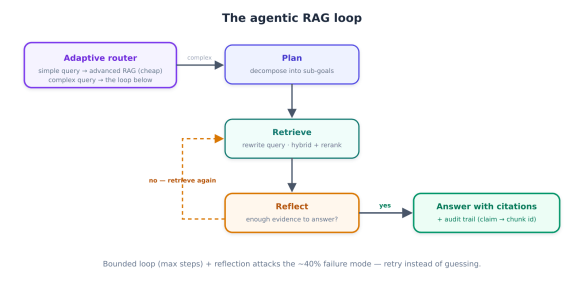
The loop, drawn from ReAct-style reasoning, looks like this:
def agentic_rag(question: str, max_steps=4) -> Answer:
    if not is_complex(question):              # adaptive routing — cost control
        return advanced_rag(question)         # simple query: one cheap pass

    goals = plan(question)                     # decompose into sub-goals
    evidence = []
    for _ in range(max_steps):                 # bounded loop — no runaway cost
        q = rewrite(next_open_goal(goals), evidence)
        evidence += retrieve(q)                # hybrid + rerank from above
        if reflect(question, evidence).is_sufficient:
            break                              # stop when grounded enough
    return synthesize_with_citations(question, evidence)
Three things make this production-grade rather than a runaway token-burner:
- Adaptive routing sends simple queries to the cheap path — you don’t pay agentic cost ($0.02–0.10/query versus ~$0.005 for advanced) on questions that don’t need it.
- A bounded loop (
max_steps) caps retrieval iterations, the same resource-bounding discipline that keeps any agent from looping forever. - Reflection lets the agent recognise when retrieval came back empty and try a different query instead of confidently answering from nothing — directly attacking the 40% failure mode.
Citation grounding, made concrete
Above, we named citation grounding as the discipline that kills synthesis hallucinations. In the pipeline it’s a hard rule on the generation step: every claim must carry the chunk ID it came from, and uncited claims are flagged rather than shipped.
SYSTEM = (
    "Answer ONLY from the provided chunks. After every claim, cite its chunk "
    "id like [c3]. If the chunks don't support an answer, say so — do not "
    "use outside knowledge. Uncited claims will be rejected."
)
# post-process: parse citations, verify each maps to a real retrieved chunk,
# and route any uncited sentence to human review instead of the user.
This is the RAG-specific form of the verification gate from the code-review: don’t trust the output, check it — here, by confirming every sentence traces to real evidence.
When to add GraphRAG (and when not to)
GraphRAG (Microsoft, open-sourced July 2024) supplements vector retrieval with a knowledge graph of entity relationships. It’s genuinely powerful for cross-document, “connect-the-dots” questions that require reasoning over relationships (“which suppliers are affected if this factory closes?”). But it earns its cost only there — for ordinary lookups it’s expensive over-engineering. Reach for it when theme-level, multi-entity reasoning is a real requirement, not before.
Measure it, or you’re guessing
Build the eval harness before you add agentic complexity, not after. Use RAGAS for faithfulness, answer relevance, and groundedness; use IR metrics (nDCG, MRR, Recall@K) to measure retrieval directly. Profile your actual query distribution to decide whether you even need the agentic path. Without this, you can’t tell whether a change helped — and in a system that fails 40% of the time at one specific step, measuring that step is the whole game.
On frameworks: use LlamaIndex when retrieval quality is your focus (its ingestion and retrieval tooling is strong), LangGraph when you need durable, stateful agentic orchestration, and LangChain to assemble something quickly. Many teams combine LlamaIndex ingestion with LangGraph control.
Start with the caveat that saves you a month
Before comparing anything, the single most useful fact in this entire post: your vector database choice accounts for maybe 5–10% of your RAG system’s quality. Chunking strategy, embedding model, retrieval pipeline, and prompting matter far more. Teams routinely agonize over Pinecone-versus-Qdrant while shipping naive retrieval that fails 40% of the time. Don’t be that team. Pick a reasonable default, get the pipeline right, and switch databases later only if scale or features force you to.
With that said, picking the wrong database can create real operational pain, so here’s how the three honestly compare.
A useful framing: as context windows have grown to a million-plus tokens, the vector DB’s role has shifted from “essential storage” to a smart retrieval layer that controls cost and improves quality. All three options below do that competently. They differ in who runs them and what they cost as you scale.
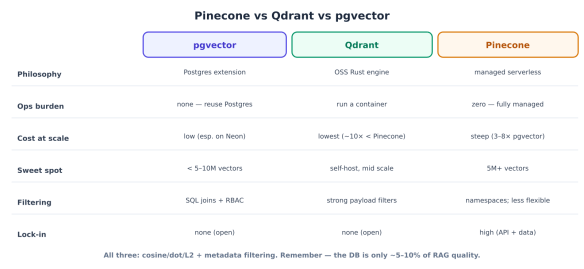
Three databases, three philosophies
pgvector — “use the database you already have”
pgvector is a PostgreSQL extension that adds vector search to the database you’re probably already running. Its whole philosophy is don’t add infrastructure: vectors live in the same tables as the rest of your data, so you get joins, transactions, and role-based access control for free, with no separate service to operate or sync.
- Best for: teams already on Postgres, under roughly 5–10 million vectors. This is the right default for most builds.
- Performance: with an HNSW index, queries return in ~5–8ms — at typical scale the database is not your latency bottleneck (embedding generation usually dominates). Performance degrades past ~10M vectors, though the
pgvectorscaleextension pushes that ceiling dramatically (benchmarks show 471 QPS at 99% recall on 50M vectors). - Cost lever: running pgvector on serverless Postgres like Neon (which scales compute to zero when idle) can cut a bursty workload’s bill from ~$260/month on RDS to ~$30–50/month. One database for app data and vectors is an underrated simplification.
Qdrant — best performance per dollar
Qdrant is an open-source vector database written in Rust, built specifically for high-throughput vector search. You can self-host it or use Qdrant Cloud, and its defining trait is economics: self-hosted on a ~$30–50/month VPS it comfortably handles 10M+ vectors — roughly 10× cheaper than equivalent Pinecone capacity.
- Best for: cost-conscious teams that can run a container, wanting the best price-performance and strong filtering.
- Strengths: very fast HNSW with excellent payload/metadata filtering (“vectors where tenant_id = X”) — important for multi-tenant and ACL-aware retrieval. Published benchmarks show ~850 QPS at p95 ~8ms on 1M vectors.
- Watch-outs: the ecosystem is smaller than Pinecone’s (though LangChain and LlamaIndex both integrate cleanly), and you should verify behaviour at your scale if you have very large datasets or heavy concurrent writes — at 50M vectors a single Qdrant node trailed pgvectorscale badly in one benchmark. Test before committing at the high end.
Pinecone — zero-ops managed scale
Pinecone is fully managed and serverless-first: there’s no infrastructure to run, indexes partition and replicate themselves, and you get consistent low-millisecond latency at essentially any scale. Multi-tenant isolation via namespaces is a clean first-class feature, and it supports dense+sparse hybrid search.
- Best for: teams with no infrastructure team, or workloads past ~5M vectors where its purpose-built scaling shines (sub-20ms p95 at 5M+).
- The trade-offs are real: you cannot tune the index to control the recall/latency trade-off — their docs say so plainly, and for some applications that opacity is fine, for others disqualifying. Cost scales steeply (often 3–8× pgvector past ~2M vectors, and “budget surprises are common”). There’s no self-hosting and meaningful vendor lock-in — the API, index format, and data are tied to Pinecone. You’re buying operational simplicity, and at scale it’s a genuine premium.
The decision, in one pass
The choice is mostly mechanical once you’re honest about scale and ops appetite.
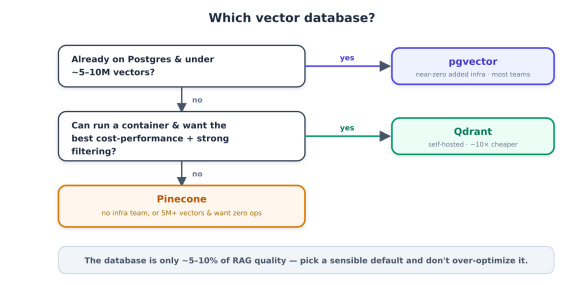
- Already on Postgres and under ~5–10M vectors? → pgvector. The migration cost is near zero and you avoid a second system entirely. This is most teams.
- Want the best cost-performance and can run a container? → Qdrant (self-hosted). ~10× cheaper than Pinecone at small-to-mid scale, with first-class filtering.
- No infra team, or past ~5M vectors and want zero ops? → Pinecone, accepting the cost curve and lock-in for genuine operational simplicity.
All three support cosine/dot-product/L2 distance and metadata filtering, so the differentiator isn’t features — it’s the operational model and the cost curve.
Keep the database swappable
One architectural habit pays for itself: hide the vector store behind a thin retrieval interface. Your pipeline should call retrieve(query), not Pinecone-or-Qdrant-or-pgvector-specific code. Then the database becomes an implementation detail you can change when scale demands — start on pgvector, move to Qdrant or Pinecone if and when you cross the thresholds above — without rewriting your application.
class Retriever(Protocol):
    def search(self, query_vec: list[float], top_k: int,
               filters: dict) -> list[Chunk]: ...

# PgvectorRetriever, QdrantRetriever, PineconeRetriever all implement this.
# The rest of the RAG pipeline neither knows nor cares which one is wired in.
The bottom line
This post traced grounding from principle to production. Retrieval, not the model, is where RAG fails — naive pipelines miss ~40% of the time, so grounding and measurement are the disciplines that matter. The fix is unglamorous and cheap — hybrid search, a reranker, good chunking, citation grounding, and an adaptive agentic loop, all measured with RAGAS and IR metrics. The database under it is a real but secondary decision — pgvector by default, Qdrant for cost-performance, Pinecone for zero-ops scale — and a thin interface keeps it swappable.
The strategic point ties back to where we started: as models commoditise, your edge is the quality of what your agent can accurately retrieve. Get the retrieval pipeline right and a knowledge-grounded agent stops being a confident liar and becomes something you can trust in production — which is the entire goal.