
Security has one brutal piece of arithmetic at its core: defenders must be right every time; attackers only need to be right once. For decades the response to that asymmetry was reactive — build taller walls, install faster alarms, and when something gets through, detect and respond. Detection-and-response (D&R) is the model that gave us SIEMs, SOCs, EDR, and the entire incident-response playbook. It works by waiting for an attack to begin, then reacting.
In 2026, that model is buckling, and the reason is speed.
Machine-speed attacks broke the reactive window
The reactive model depends on a window: the time between an attack starting and a defender responding. That window has now collapsed toward zero, because attackers have AI too.
The numbers tell the story. Roughly 40,000 new CVEs were logged in 2024 alone — a 38% jump over the prior year — and adversaries now use generative AI to chain those flaws into attacks at machine speed, weaponising exposed services and misconfigurations within minutes of discovery. As one industry forecast put it bluntly: “AI-fueled attacks start and end before a ticket is even created.” When the attack completes faster than your SOC can open a case, faster alarms don’t help. You can’t respond your way out of an attack that’s already over.
The crucial nuance — and it’s good news for defenders — is that AI mostly isn’t creating brand-new attack vectors; it’s supercharging the speed and volume of existing ones. That means the fundamentals still work. What has to change is when you apply them. If you can’t win the race to respond, you have to win before the race starts.
What “pre-emptive” actually means
This is the shift the industry is now naming pre-emptive cybersecurity — and it’s not just a marketing rebrand. Gartner has formalised it as a primary strategic technology trend for 2026 and projects that about 35% of cybersecurity solutions may be pre-emptive by 2028.
Pre-emptive cybersecurity is a proactive approach that identifies, predicts, and neutralises potential threats before they can execute an attack. The analogy that captures it: reactive security is a smoke detector and a fire extinguisher; pre-emptive security is fireproofing the house, so the fire either never starts or gets snuffed out while it’s still an ember. You act on the early warning signs and the exploitable conditions before the adversary moves, rather than responding after.
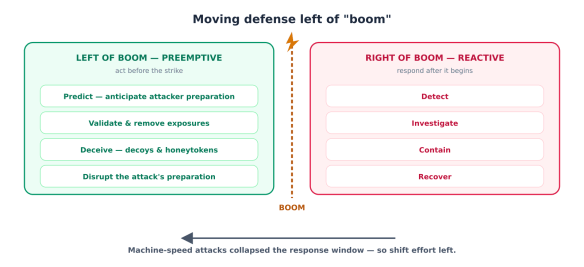
Security people call the moment of compromise “boom.” Reactive security lives right of boom — everything after the attack begins. Pre-emptive security moves the work left of boom — into the period when, as the framing goes, cyberattacks aren’t random: attackers research their targets, test methods, and build tools before they strike. That preparation phase is an opportunity, and pre-emptive defence is about exploiting it.
Proactive vs. pre-emptive: the validation distinction
Here’s a distinction worth getting right, because it separates the real thing from the hype. “Proactive” and “pre-emptive” are not synonyms. Plenty of tools are proactive — they scan for vulnerabilities, flag misconfigurations, and produce long lists of theoretical risk. The trouble is that a list of 40,000 possible problems isn’t a defence; it’s a different kind of alert fatigue.
Gartner draws the line at validation. Security becomes genuinely pre-emptive only when it validates real attack feasibility — confirms that a given exposure could actually be exploited in your environment — and then mobilises mitigation before impact. Without that validation and early action, you’re proactive at best: busy, but not safe. Validation is the inflection point, and it’s exactly the step AI makes fast enough to matter.
The framework: Deny, Deceive, Disrupt
Pre-emptive cybersecurity organises around three strategies — the “3 D’s” — each aimed at stopping an attacker before they can execute.
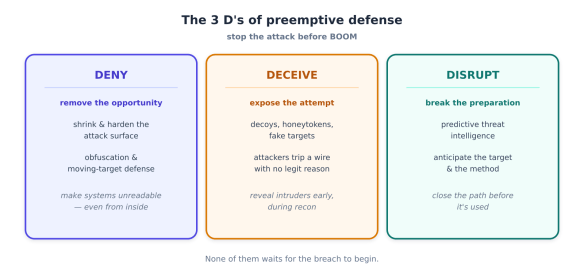
- Deny — make the attacker’s job impossible by removing what they need. This is exposure management (find and eliminate the exploitable weaknesses) plus obfuscation and moving-target techniques that make systems unreadable or invisible to unauthorised users — mitigating even ransomware and APTs that have already gotten inside, because there’s nothing legible for them to exploit.
- Deceive — seed the environment with decoys, honey tokens, and fake targets. An attacker probing your network trips a tripwire that has no legitimate reason to be touched, revealing themselves early and wasting their effort on a phantom.
- Disrupt — use predictive threat intelligence to anticipate the attack and interfere during its preparation phase: pre-empting an exploit before it’s weaponised against you, disrupting infrastructure, or closing the validated path the attacker was about to use.
Deny removes the opportunity, Deceive exposes the attempt, Disrupt breaks the preparation. None of them waits for boom.
Why this needs AI (and why now)
You might reasonably ask: if attackers research and prepare before striking, why hasn’t pre-emptive defence always been the norm? Because at human speed it was impossible to keep up. Validating which of 40,000 CVEs are actually exploitable in your environment, continuously, across a sprawling multi-cloud and SaaS estate — and then remediating before an adversary weaponises them within minutes — is not a human-scale task. It’s the AI uplift that makes pre-emptive defence practical in 2026: AI is what compresses “validate the exposure” from weeks to hours, and “decide what to fix first” from a guessing game to a ranked, evidence-backed plan.
Attackers got faster with AI; defenders match them not by responding faster (a race they’ll lose) but by moving the fight left of boom with AI.
From CTEM to pre-emptive exposure management
The foundation is Continuous Threat Exposure Management (CTEM) — the Gartner-defined discipline of continuously discovering and prioritising exposures rather than running periodic scans. CTEM was a real advance, but it has a gap: even mature CTEM programs discover and prioritise faster than they can remediate. You end up with an excellent, continuously-updated list of problems and a remediation backlog that adversaries outrun.
Pre-emptive Exposure Management (PEM) closes that gap. It unifies three things into one automated loop — continuous discovery, risk-based validation, and automated remediation — with the explicit objective of shrinking the remediation gap toward zero: exposures removed before threat actors can reach them.

The pipeline has four stages, and the second one is where pre-emption is won or lost:
- Discover — continuously inventory assets, exposures, and the attack surface across endpoint, cloud, SaaS, and the software supply chain. With ~40,000 new CVEs a year, discovery is necessary but produces overwhelming volume.
- Validate — AI confirms whether each exposure is actually reachable and exploitable in your specific environment, using attack-path analysis and breach-and-attack simulation. This is the step that turns “40,000 theoretical problems” into “the 50 an attacker could actually use against us.” One vendor reports AI cutting attack-surface validation from weeks to hours.
- Prioritise — rank the validated, reachable exposures by business impact and real exploitability, not raw CVSS score. A “critical” CVE on an unreachable asset matters less than a “medium” on the path to your crown jewels.
- Remediate — automatically fix, virtually patch, or harden the prioritised exposures before exploitation. After years of caution, automated remediation is getting the go-ahead in 2026, because the alternative — manual patching at human speed — loses to machine-speed weaponisation.
Conceptually, the loop gates on validation rather than firing on every finding:
def preemptive_loop(environment):
    for exposure in discover(environment):           # continuous, high-volume
        reachable = validate_exploitability(exposure, environment)  # the inflection
        if not reachable:
            continue                                 # de-prioritise: not a real path
        risk = score(exposure, blast_radius(exposure, environment))  # impact, not CVSS
        if risk >= AUTO_REMEDIATE_THRESHOLD:
            remediate(exposure)                      # fix / virtual-patch before boom
        else:
            queue_for_review(exposure, risk)         # human triage for the rest
Note what validation buys you: the expensive remediation effort is spent only on exposures that are real attack paths, not on the long tail of theoretically-scary-but-unreachable findings that drown traditional vulnerability management.
The techniques, mapped to the 3 D’s
Exposure management is the backbone, but the full pre-emptive toolkit spans all three strategies. Here’s how the AI techniques line up.
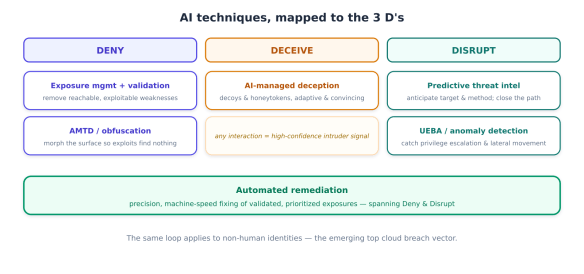
Deny — remove the opportunity:
- AI-driven exposure management with validation (the pipeline above) eliminates the exploitable weaknesses before attackers reach them.
- Automated Moving Target Defence (AMTD) and obfuscation continuously morph the runtime attack surface — memory layout, application structure — so that even a working exploit finds nothing where it expects it. This is the “make systems unreadable” leg of Deny, and it mitigates ransomware and APTs even when the attacker is already inside, because there’s no stable target to exploit.
Deceive — expose the attempt:
- AI-managed deception seeds the environment with decoys and honey tokens that legitimate users have no reason to touch. AI makes the decoys convincing and adaptive, and any interaction is high-confidence evidence of an intruder — caught during reconnaissance, long before impact.
Disrupt — break the preparation:
- Predictive threat intelligence models attacker behaviour and infrastructure to anticipate what will be targeted and how, so you can close the path the adversary was about to use. This is the “attackers research and build before they strike” window, turned into a defensive advantage.
- Behavioural analytics (UEBA) and anomaly detection baseline normal behaviour for users, machines, and — increasingly — non-human identities, then flag the deviations that precede damage: privilege escalation, anomalous identity behaviour, lateral movement. Catching the precursor behaviour is pre-emption applied to an attacker who’s already gotten a foothold.
Spanning Deny and Disrupt: automated remediation. Once an exposure is validated and prioritised, AI agents perform precision remediation — patch, virtual-patch, reconfigure, or revoke — at machine speed, closing the gap before it’s exploited.
The non-human-identity front
One area deserves a specific call-out because forecasts converge on it: machine identities are becoming the top cloud breach vector. Every service, workload, and AI agent is a non-human identity (NHI) with credentials, and NHIs now sprawl faster than humans can govern them. The pre-emptive answer is the same loop applied to identity: continuously discover NHIs, validate which have excessive or exploitable permissions, prioritise by what they can reach, and automatically remediate — tightening scopes and revoking standing access before an attacker (or a hijacked agent) abuses them.
The limits
Pre-emptive defence is powerful, not magical, and two cautions keep it credible. First, validation quality is everything — a pre-emptive program that miscalibrates exploitability will either drown you in false “reachable” findings or auto-remediate things that didn’t need it (and auto-remediation can break production, so the threshold for autonomous action must be set conservatively and the rest routed to humans). Second, pre-emption complements rather than replaces detection-and-response; you still need eyes right of boom for the attacks that slip the net. The shift is one of emphasis and timing — moving the centre of gravity left — not an abandonment of the reactive stack.
Why the SOC had to change too
The reactive operations centre is breaking with it. Traditional SOCs drown in alert fatigue, stitch together fragmented tools, and triage by hand — and the gap between attack speed and response speed is exactly where breaches happen. Telemetry grows faster than budgets, so teams filter data before ingestion just to control cost, dropping the very signals an attacker exploits. You cannot run a machine-speed, left-of-boom defence on a human-speed, tool-sprawled SOC.
Platformisation: SIEM becomes the orchestration layer
The first half of the answer is architectural consolidation. The old stack — separate SIEM, XDR, SOAR, threat intel, and exposure management products — is converging into unified platforms built on a shared data layer. SIEM itself is transforming: not dying, but evolving from passive log storage into the AI-driven orchestration layer for unified detection, investigation, and response. The modern SIEM market reflects the momentum, projected to grow from £5.58 billion in 2024 to £10.05 billion by 2029.
The consolidation is visible in the market moves: Palo Alto absorbed IBM QRadar SaaS customers into Cortex XSIAM; Google expanded Chronicle into Google SecOps; Microsoft unified Sentinel with Defender and Security Copilot. The buyer’s advantage is real — converged platforms eliminate separately licensing SIEM, XDR, and SOAR, and cut the integration overhead of bolting tools together. The evaluation rule that matters: look for platforms where detection, investigation, and response share a unified data layer, not capabilities stitched across product tiers.
The structural enabler underneath is data normalisation. The Open Cybersecurity Schema Framework (OCSF) — now under the Linux Foundation — provides vendor-agnostic schema standardisation, which makes federated search, cross-platform correlation, and portable detection rules possible regardless of which platform you run. The principle is simple and important: AI-driven detection only works when data is normalised across sources. Garbage-in still applies, and OCSF is how you avoid it.
The agentic SOC
The second half of the answer is the agentic SOC. An agentic SOC deploys autonomous AI agents that triage alerts, investigate incidents, correlate evidence across identity/endpoint/cloud, verify suspicious activity, and execute response actions — reasoning through novel scenarios rather than just running pre-written SOAR playbooks.
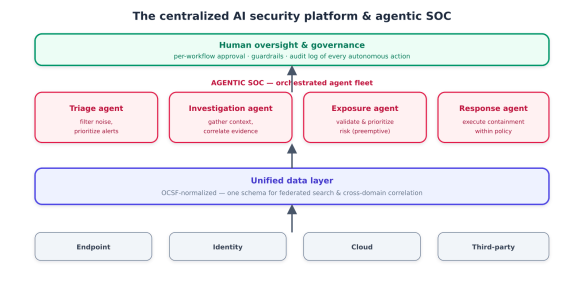
The platform incumbents have all built toward this:
- CrowdStrike Charlotte AI orchestrates a fleet of purpose-built agents (triage, investigation, exposure prioritisation, and more) via Charlotte Agentic SOAR, with AgentWorks letting teams build custom agents in natural language — explicitly “always under human control,” with per-workflow oversight and audit logging.
- Palo Alto Cortex XSIAM / AgentiX consolidates endpoint, network, cloud, identity, and third-party data on the Cortex data lake.
- Microsoft Sentinel + Security Copilot and Google SecOps (with Gemini) take the same unified-platform approach.
- SentinelOne Purple AI layers agentic investigation over hyper automation, reporting 63% faster detection and 55% faster remediation, with 70% better platform-management efficiency.
The market has crystallised into recognisable architecture models: a single-agent copilot embedded in a platform (Charlotte), a multi-agent mesh of collaborating specialists, a hyper-automation-layered approach (SentinelOne), and a hybrid human-AI model where AI triages and humans own the last mile. Which one fits depends on your team’s maturity and existing stack — but every credible one keeps humans in command.
The autonomy spectrum — and keeping humans in command
The most important design decision in an agentic SOC isn’t which vendor; it’s how much autonomy you grant, on which actions. The field runs along a clear spectrum, and the right answer is rarely the far end.

The pattern that works mirrors the human-checkpoint discipline from across this whole library: AI handles the high-volume, repetitive work — filtering noise, correlating signals, triaging alerts, executing routine, pre-approved response — and humans own the judgement calls and the last mile, especially irreversible containment. The stated goal of every serious platform is to make analysts more effective, not absent: a team that operates at higher scale without higher headcount, not a team that’s been automated away. Tier the autonomy by blast radius — generous on reversible, low-risk actions; mandatory human approval on high-impact ones — and log every autonomous action for audit. (And remember: an agentic SOC is itself an agent system, so everything — least privilege, governance, decision-level audit — applies to your defenders too.)
The catch: consolidation and lock-in
We have to name the trade-off, because the consolidation that delivers the efficiency also concentrates risk. Analysts compare the current moment to the CASB and SASE waves of 2018–2020 — a category “graduating from venture experiment to enterprise category,” consolidating around a small number of well-funded players, with acquisitions of the independents widely expected. The convenience of a single converged platform comes with vendor lock-in: a deeply integrated agentic SOC is, in one analyst’s words, “an ecosystem play, not a vendor-agnostic one,” and its value can diminish sharply in a multi-vendor environment where the agents can’t reach across stacks.
The practical hedges are worth building in from the start:
- Insist on OCSF-normalised data so your telemetry and detection logic stay portable if you change platforms.
- Keep an integration path for existing tools rather than ripping-and-replacing everything into one vendor.
- Validate at your real data volume and on your oldest assets before committing — converged pricing and agent performance both change at scale.
- Watch the build-vs-buy line: some teams are building custom in-house AI security tooling precisely to avoid lock-in and tailor to their environment.
Consolidation is the right default for most teams — the efficiency and the unified data layer are genuinely how you achieve machine-speed defence — but go in with eyes open about the dependency you’re taking on.
The whole picture
Attacks went machine-speed, so reactive defence lost its window, and the answer is to move left of boom with pre-emptive defence built on the 3 D’s. AI executes that defence through a continuous discover–validate–prioritise–remediate loop plus deception, moving-target defence, and predictive intelligence. And all of it converges onto centralised, AI-native platforms with a unified data layer and an agentic SOC, where AI agents run the high-volume work at machine speed and humans stay in command.
The strategic truth underneath is simple: you fight AI-speed offence with AI-speed defence, applied before the strike rather than after it. The teams that win the next few years won’t be the ones with the fastest alarms. They’ll be the ones who moved the fight left of boom, validated what actually matters, automated the remediation of it, and kept human judgement exactly where the stakes are highest.