
To understand where cloud is going in 2026, it helps to see where it’s been — because the change underway is a genuine paradigm shift, not an incremental one.

Cloud 1.0 — migration. Organisations moved to the cloud to shed the “undifferentiated heavy lifting” of managing hardware. The question was simply can we run this in the cloud? — lift-and-shift, IaaS, someone else’s servers.
Cloud 2.0 — cloud-native. The era of “cloud first.” Teams rebuilt around managed services, autoscaling, and the seemingly infinite capacity of a handful of hyperscalers. The question became how fast can we scale? Concentration on a few global providers was a feature, not a worry.
Cloud 3.0 — sovereignty-first. As we move through 2026, the primary driver is no longer “the cloud as a place to run code” but “the cloud as a jurisdictional and strategic asset.” Organisations are no longer content to have their data “somewhere in the ether” — they need to know exactly which laws govern it, who has the technical ability to access it, and how it fits an increasingly fragmented global regulatory landscape. The defining question is now where, and under whose laws, does this run?
Cloud 3.0 is characterised by a small set of ideas that separate it from its predecessors: sovereignty (data under local or regional control), resilience (designed to keep working through disruption), hybrid flexibility (workloads move between private, public, and edge), built-in compliance (governance is part of the architecture, not bolted on afterward), and AI readiness (built to support training and real-time inference). Instead of depending mainly on large public clouds, organisations are adopting a more balanced model spanning hybrid, multi-cloud, sovereign, and edge.
Geopatriation: the defining 2026 trend
The strategic move at the centre of Cloud 3.0 has a name. Gartner identified “geopatriation” as a defining enterprise trend for 2026: the deliberate shift of data and workloads from global public clouds to local sovereign or regional alternatives.
It’s worth distinguishing geopatriation from plain cloud repatriation. Repatriation, the older idea, is mostly cost-driven — pulling workloads back to on-prem to escape unpredictable bills. Geopatriation is jurisdiction-driven — the strategic relocation of critical workloads to local or private infrastructure (or nationally hosted “sovereign enclaves”) to control which laws and which governments can reach them. Crucially, it is not an abandonment of the cloud — it’s a refinement of it. Most companies aren’t deleting their AWS accounts; they’re deciding which workloads belong where. The conversation has shifted from whether to localise to which workloads to localise first.
The market signals are not subtle. Worldwide sovereign cloud spending is forecast to reach $80 billion in 2026 — a 35.6% jump from 2025. Gartner reports 61% of European CIOs want to reduce dependency on US cloud providers; Accenture finds 62% of EU organisations actively seeking sovereign solutions — against a backdrop where US hyperscalers hold roughly 70% of the EU cloud market. And three-quarters of business leaders say they’re concerned about the geopolitical risks of storing data in global clouds. Cloud strategy has moved from an IT decision to a boardroom one.
The forces driving it
Five forces converge to push workloads toward sovereign and regional providers. As a developer or architect, you’ll feel all of them as requirements landing on your roadmap.

Geopolitical tension. Trade wars, export controls, digital sanctions, and a fragmenting “splinternet” make relying on a provider headquartered in another country a genuine strategic risk. If geopolitics sours, your infrastructure shouldn’t be a hostage.
Legal and extraterritorial access. The US CLOUD Act lets US authorities compel US-headquartered providers to hand over data regardless of where it’s physically stored, and the collapse of the EU-US Privacy Shield (the Schrems saga) underscored the exposure. Enterprises increasingly want environments governed solely by local law, with guarantees against external authorities.
Regulation. GDPR, the financial-sector DORA, the network-security NIS2, and the EU AI Act are making sovereign or residency-controlled hosting mandatory for specific workloads — and the proposed EU Cloud and AI Development Act (expected Q1 2026) aims to triple EU data-centre capacity to support it. For regulated buyers, your sovereignty posture now affects whether they can even purchase from you.
The AI data grab. This one is newer and underappreciated. Public providers increasingly use the data on their platforms to train their own models — so if your “secret sauce” lives on a public cloud, it can effectively be donated to the broader model (and your competitors). For proprietary datasets, that’s an unacceptable leak.
Cost. The classic repatriation driver still applies: the “cloud tax” of escalating egress fees and unpredictable consumption volatility pushes high-volume workloads toward more predictable, locally-controlled infrastructure.
The reframe: cloud as strategic territory
Put these together and the mindset shift is clear: the move from “Cloud First” to “Sovereignty First.” The cloud is no longer a featureless utility you rent by the hour; it’s regulated, strategic territory with borders, jurisdictions, and access rules that matter to your business and your compliance officer alike. Navigating it is no longer a purely technical challenge — it’s a risk-management priority that happens to land on engineers to implement.
This doesn’t mean the hyperscalers lose. It means the default of “throw everything in one global public cloud and scale” is over. The winning pattern is deliberately placing each workload where it belongs — public cloud for scale, sovereign or private for sensitive data and IP, edge for latency — and being able to prove which laws govern what.
The Hybrid Sovereign model
The architecture most enterprises are converging on is “Hybrid Sovereign”: use public clouds for scale, and sovereign or private environments for sensitive IP and regulated data. It’s the end of “one-size-fits-all” infrastructure in favour of routing each workload by its sensitivity, compliance exposure, and latency needs.

The three destinations:
- Public cloud — for scale. Non-sensitive workloads, front-end web hosting, global content delivery, and elastic burst capacity. This is where the hyperscalers’ breadth and economics still win.
- Sovereign or private — for control. Mission-critical IP, personal data (PII), and regulated workloads that must be governed under local law and shielded from foreign access.
- Edge and regional zones — for proximity. Latency-sensitive and localised processing kept close to users, which also helps keep data within a jurisdiction.
The encouraging part for engineers: the cloud-native skills you built in the Cloud 2.0 era still apply. What changes is where each workload lands and who can technically reach it — a placement and governance problem layered on top of the same containers, pipelines, and services.
The three layers of sovereignty
Here’s the distinction that separates real sovereignty from marketing, and the single most important concept in this post for an architect to internalise. “Sovereign” is not one thing — it’s three escalating layers, and vendors blur them constantly.

- Data residency — your data is physically stored in a chosen region. This is table stakes: standard cloud regions already offer it, and on its own it is not sovereignty. Residency answers “where are the bytes?” — not “who can compel access to them?”
- Data sovereignty — the data is governed solely by local law. This adds legal control: which jurisdiction’s rules apply.
- Operational sovereignty — the environment is operated by local personnel under local jurisdiction, with technical controls preventing outside access — even by the provider’s own staff, even under a foreign legal order. This is the bar that actually answers the CLOUD Act concern.
The trap is “sovereignty-washing”: marketing data residency as full sovereignty. And even genuine local providers aren’t automatically immune — an EU-native provider was reportedly subject to a Canadian court order, a reminder that corporate structure and legal exposure matter as much as where the servers sit. The rule: verify technical controls; don’t trust contractual promises alone.
The offerings (as of 2026)
The hyperscalers responded with distinct architectures, and the differences map directly onto those three layers.
- AWS European Sovereign Cloud (ESC) — generally available January 15, 2026, a €7.8 billion investment. It’s a new, fully independent AWS partition operated, governed, and controlled entirely within the EU: its own control planes, IAM, billing, and metadata handling, run by EU-resident personnel under a German parent entity. It launches with ~90 services and Local Zones in Belgium, the Netherlands, and Portugal. This reaches operational sovereignty — the most isolated option among the US hyperscalers — and crucially, its Nitro Enclaves provide hardware-enforced confidential computing that even AWS operators cannot bypass, independently reviewed by NCC Group. That last point matters: it makes the sovereignty claim verifiable rather than just a policy.
- Microsoft — a layered approach: an EU Data Boundary, a European board, a “Data Guardian” approval system, and national partner clouds run by European joint ventures. In February 2026 it added M365 Local and Foundry Local, bringing productivity software and AI inference onto customer-owned hardware, disconnected from the public cloud — plus a commitment to in-country Microsoft 365 Copilot processing for 15 nations by end of 2026, and a Sovereign Landing Zone for workload classification and residency policy.
- Google — Distributed Cloud (air-gapped) delivers environments fully disconnected from the internet and public cloud, so you can run AI and analytics on highly sensitive data, plus a partner-operated model for jurisdictions requiring local operation.
- Oracle — an EU Sovereign Cloud with EU-resident operations.
- EU-native providers — Hetzner, OVHcloud, Scaleway, and T-Systems offer European-headquartered alternatives, attractive when reducing exposure to US corporate jurisdiction is the goal (with the OVHcloud court-order nuance above as a caution that “EU-native” still needs due diligence).
- GAIA-X — the broader European federated-cloud initiative aiming for interoperable, sovereignty-respecting infrastructure across providers.
The engineering controls that make it real
Sovereignty isn’t only contracts and corporate structure; it’s enforced in code and silicon. Two technical controls do the heavy lifting, and both are things you implement.
Confidential computing — protect data in use. Encryption at rest and in transit is standard; the gap was always data during processing, when it sits decrypted in memory. Confidential computing closes it with hardware-enforced enclaves (AWS Nitro Enclaves, Intel SGX/TDX, AMD SEV) that isolate computation and provide cryptographic attestation of code integrity — so sensitive data can be processed in an environment the provider’s own operators cannot read. This is what lets you run sensitive analytics or AI on infrastructure you don’t fully own.
Key-first security — BYOK / HYOK. The decisive question for access control is who holds the keys? A “key-first” policy ensures that your organisation — not your provider — holds the ultimate power over data access. With Bring-Your-Own-Key (BYOK) or Hold-Your-Own-Key (HYOK), encryption keys live in a key store you control; if the provider can’t decrypt without your key, a legal order served on the provider yields ciphertext. Combined with confidential computing and residency, key-first control is how operational sovereignty becomes technically true rather than merely promised.
A useful way to enforce residency at the architecture level is policy-as-code — the same governance-in-the-pipeline discipline, pointed at jurisdiction:
def admit_deployment(workload, target_region, policy) -> bool:
    cls = classify(workload)              # public / sovereign-required / air-gapped
    if cls == "air-gapped" and target_region.connected_to_internet:
        return reject("air-gapped workload cannot deploy to a connected region")
    if cls == "sovereign-required" and target_region.jurisdiction not in policy.allowed_jurisdictions:
        return reject(f"data residency violation: {target_region.jurisdiction}")
    if cls != "public" and not workload.keys.customer_held:
        return reject("sensitive workload requires customer-held keys (BYOK)")
    return True   # placement satisfies residency, jurisdiction, and key policy
The gate is deliberate: a workload’s classification, not a developer’s convenience, decides where it can land.
The AI placement problem
The core architectural decision is where each part of the AI lifecycle runs, and the answer isn’t one place — it’s a deliberate split by two axes: how sensitive the data is, and how compute-intensive the work is.
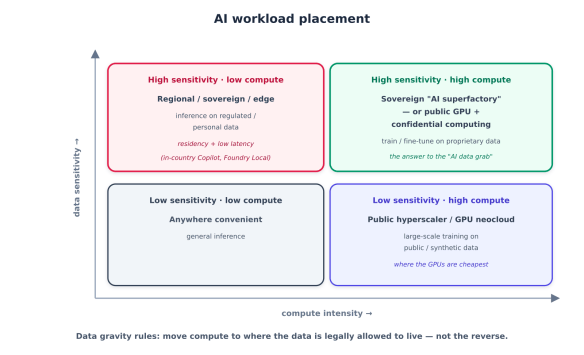
Reading the quadrants:
- High compute, low sensitivity (large-scale training on public or synthetic data) → run it where the GPUs are cheapest and most plentiful: public hyperscalers or GPU-rich “neoclouds” (regional specialist GPU providers). Sensitivity is low, so cross-jurisdiction compute is acceptable.
- High compute, high sensitivity (training or fine-tuning on proprietary data) → this is the hard quadrant. Options: a sovereign or private “AI superfactory” where proprietary datasets fine-tune models without ever touching the public internet, or public GPUs wrapped in confidential computing so even the provider can’t read the data in use. This is the direct answer to the “AI data grab”.
- High sensitivity, low compute (inference on regulated or personal data) → regional, sovereign, or edge infrastructure for both residency and latency. Microsoft’s in-country Copilot processing and Foundry Local (on-device inference) exist precisely for this.
- Low sensitivity, low compute → run it wherever is convenient.
The organising principle is data gravity: it’s far easier to move compute to where data is legally allowed to live than to move regulated data to where the compute is. Architect AI systems so the data anchors the placement, not the other way around.
Sovereign AI is the macro trend behind this: nations and enterprises building local AI capacity so that strategic compute and sensitive data stay within their borders — and AI-optimised sovereign environments (and neoclouds) are emerging to serve exactly that demand.
The geopatriation playbook
Here’s the actionable part — the roadmap practitioners are converging on for executing geopatriation without breaking what works or trading one lock-in for another.

- Audit for dependency. Map your data flows and the jurisdictions they cross, and identify “locked” workloads — the ones wired so tightly to proprietary managed services they can’t easily move. You can’t relocate what you can’t see.
- Classify workloads. Tier each workload by data sensitivity, regulatory exposure, and latency need into public-OK / sovereign-required / air-gapped. This is the “which workloads first” decision, made concrete — and it’s the input to the placement gate.
- Design for exit. The antidote to lock-in (including lock-in to a sovereign provider): containers and Kubernetes, open standards, infrastructure-as-code, and abstraction layers over provider-specific services where exit matters. “Exit architecture” means you can move a workload if jurisdiction, price, or geopolitics forces it.
- Implement confidential computing. Protect data during the high-value processing phase, not just at rest and in transit — the enclave-and-attestation pattern.
- Adopt key-first security. Hold your own keys (BYOK/HYOK) so you, not the provider, hold ultimate power over access. A legal order served on a provider that can’t decrypt yields nothing useful.
- Build in compliance. Enforce residency and jurisdiction with policy-as-code, mapping workloads to the regulations that bind them (GDPR, DORA, NIS2, EU AI Act). Governance belongs in the pipeline, not in a quarterly audit — the same “built-in, not bolted-on” principle that runs through the security and provenance themes.
The honest trade-offs
A credible playbook names its costs, and geopatriation has real ones. Don’t let the strategic urgency stampede you past them.
- The sovereignty tax. Sovereign environments typically offer fewer services, higher cost, slower feature rollout, and smaller GPU pools than the global commercial regions. AWS ESC launched with ~90 services versus the full commercial catalogue; sovereign AI capacity is scarcer than hyperscale. Sovereignty buys control at the price of some capability and economics — budget for it.
- Sovereignty isn’t binary, and “sovereign” is marketed loosely. Re-apply the test: residency ≠ operational sovereignty, and even EU-native providers can face foreign legal orders. Verify technical controls (independent review, hardware attestation), not just contractual language.
- Complexity is the hidden bill. Multi-partition and multi-cloud operations mean separate control planes, IAM, billing, and tooling (AWS ESC is a wholly separate partition, by design). Fragmentation costs skills, money, and operational surface area. Multi-cloud is not free resilience — it’s deliberate engineering with real overhead.
- Don’t over-rotate. Geopatriation is selective refinement, not a wholesale cloud exit. The whole point of Hybrid Sovereign is that most workloads stay on public cloud for scale; you move the ones where jurisdiction, IP, or regulation justify the tax. Resist the temptation to “sovereign everything” — it’s expensive and usually unnecessary.
The whole picture
Step back and the three parts form one architecture for the 2026 cloud. Cloud became a jurisdictional and strategic asset (Cloud 3.0), and geopatriation — moving workloads to sovereign and regional providers — is the defining response to geopolitical, legal, regulatory, AI-data, and cost pressures. The architecture is Hybrid Sovereign, routed by workload classification across public, sovereign, and edge, with sovereignty understood as three layers (residency → data → operational) and made real by confidential computing and key-first control. AI is the hardest case — placed by data sensitivity and compute intensity, anchored by data gravity — and the geopatriation playbook (audit, classify, design for exit, confidential computing, key-first, built-in compliance) executes it without trading scale for a new lock-in.
The strategic truth underneath: in a fragmenting world, where your workloads run, and under whose laws, is now an architectural decision with business and compliance consequences — and increasingly an AI decision, since the most valuable models are trained on the most sensitive data. The teams that map their jurisdictional dependencies, classify deliberately, and design for exit will move fast and stay compliant. The ones who treat the cloud as a borderless utility will discover, at the worst possible moment, that it never was.