Anthropic ships major Claude updates almost weekly, which makes staying current with the platform a genuine full-time problem — even the best deep-dive guides go stale within weeks of publication. Claude AI: The Complete Guide solves that by treating currency as a feature: every pricing figure, benchmark, and model spec is timestamped, every correction from prior editions is called out explicitly rather than quietly fixed, and this August 2026 revision covers everything from the new Claude Opus 5 to the Fable 5/Mythos 5 export-control saga that briefly took two flagship models offline worldwide. Whether you’re writing your first API call or architecting a production agentic system, this is the rare technical reference built to be re-read as it’s updated, not just read once and left to rot on a shelf.
You start with one coding assistant and it’s great. So you add a second agent to review the first. Then a planner. Then a tester. Each addition feels reasonable, and somewhere around the fourth one the system starts to wobble: the logs balloon, the agents make contradictory decisions, costs spike, and you’re back babysitting it at 2 a.m. wondering whether all this orchestration actually bought you anything.
That tension — more power versus more pain — produced one of 2025’s sharpest engineering disagreements. On June 12, Cognition (the team behind Devin) published “Don’t Build Multi-Agents,” arguing that parallel subagents make independent decisions on shared problems and produce conflicting, fragile output. Less than 24 hours later, Anthropic published “How we built our multi-agent research system,” reporting a multi-agent architecture that outperformed a single agent by 90.2% on their research evaluation. Two of the most respected teams in the field, opposite conclusions, same week.
Here’s the thing: they’re both right. Resolving that apparent contradiction is the key to using multi-agent systems well — and it starts by recognising what these systems actually are.
Multi-agent orchestration is distributed systems
The most useful reframe in this whole topic: you are not inventing something new. A team of agents passing messages, delegating work, and sharing state is a distributed system, and the patterns have names that predate LLMs by decades — orchestrator-worker, pipeline, message bus, blackboard, the actor model. The failure modes are the classic distributed-systems failure modes too: race conditions, cascading failures, coordination overhead, partial failure.
Separation of concerns, single responsibility, clear interfaces, idempotency, error handling, observability, bounded resources — everything you already know about building reliable systems still applies, and applies harder, because you’ve added a new source of nondeterminism on top. The teams that fail with multi-agent treat it as a vibe. The teams that succeed treat it as an engineering problem with known patterns and known failure modes. As one widely-shared 2026 benchmark put it bluntly: the gap between a good agent system and a bad one is almost never the framework — it’s the eval pipeline, the observability, and the failure-recovery logic.
When multi-agent actually helps
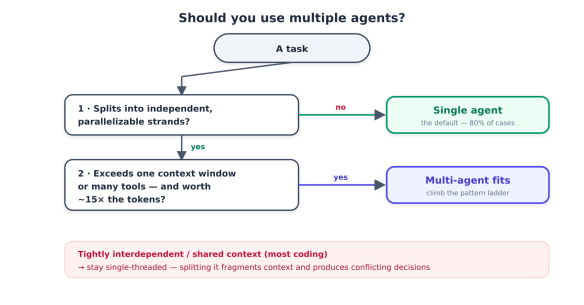
Anthropic and Cognition don’t actually disagree on the principle; they were describing different workloads. Anthropic’s own write-up is explicit about the boundary. Multi-agent systems earn their keep when a task has:
Heavy parallelism — it splits into independent strands that don’t need to talk to each other.
Information that exceeds a single context window — more material than one agent can hold, so you spread it across several windows.
Many complex tools to coordinate.
High enough value to justify the cost — and the cost is real: their multi-agent system used roughly 15× the tokens of a single chat.
And they’re equally explicit about when it doesn’t fit — which, notably, includes most coding:
“Most coding tasks involve fewer truly parallelisable tasks than research, and LLM agents are not yet great at coordinating and delegating to other agents in real time.”
That’s the resolution of the debate. Research parallelises beautifully — five subagents investigate five subtopics in isolation and report back. Coding often doesn’t, because changes are tightly interdependent: the function you’re writing depends on the type the other agent just changed. Cognition’s point is that splitting tightly-coupled work across agents fragments the context each one needs, and they make conflicting decisions. Anthropic’s point is that splitting loosely-coupled work across agents is a superpower. Both true.
The default is still one agent
Before any pattern, internalise the most important rule: start with a single, well-prompted agent with good tools. It handles something like 80% of what people reach for frameworks to solve. Multi-agent is the exception you reach for when a single agent hits a hard wall — a context-window limit, a genuinely parallel workload, a tool-coordination problem — not the default architecture. This is the same instinct as “start with the monolith”: don’t pay distributed-systems complexity until a real constraint forces you to.
The pattern ladder
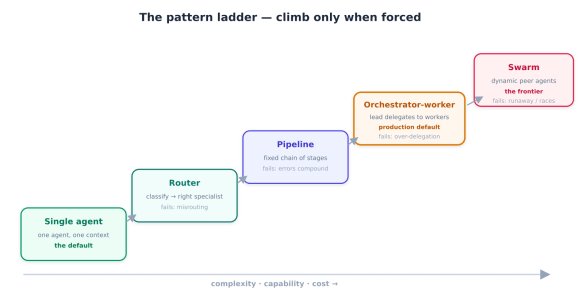
When you do go multi-agent, you’re choosing a topology, and there’s a clear ladder from simplest to most complex. Each rung adds capability and cost, and each has a characteristic failure mode worth knowing before you climb.
Single agent — one agent, one context window, a good toolset. The baseline and the right answer most of the time.
Router — a lightweight classifier inspects each request and sends it to the right specialist agent. Still single-agent execution; you’ve just picked which one. Cheap and reliable. Failure mode: misrouting.
Pipeline (sequential) — agents in a fixed chain, each transforming the previous one’s output: writer → editor → fact-checker. Deterministic and easy to reason about. Failure mode: errors compound down the chain.
Orchestrator-worker (supervisor) — a lead agent decomposes a task and delegates sub-tasks to specialised workers, then synthesises their results. This is what production looks like in 2026, with the widest framework support (Claude Agent SDK, LangGraph, OpenAI Agents SDK, CrewAI’s hierarchical process). Failure mode: over-delegation — the orchestrator spawning workers endlessly — which you bound with iteration ceilings.
Swarm — a dynamic, open-ended population of peer agents that coordinate through shared memory or a message bus rather than a fixed coordinator. The frontier, powerful for massively parallel work. Failure modes: runaway spawning and shared-state race conditions, which you bound with population caps and concurrency safeguards.
Start at the bottom and climb only when forced. Most teams that succeed land on orchestrator-worker; most teams that fail jumped to a swarm because it sounded impressive.
A preview of the failure surface
One sobering data point to carry forward: a Berkeley research team catalogued 14 distinct failure modes specific to multi-agent LLM systems — things like agents losing track of who’s responsible for what, conversations derailing, and one agent’s error propagating through the whole team. These sit on top of every normal software failure mode, not instead of them. Multi-agent doesn’t replace your reliability engineering; it demands more of it. That’s the subject we keep returning to.
Building a Team of Coding Agents
We’ve just hit an uncomfortable truth: most coding isn’t parallelisable, so a team of coding agents is the exception, not the rule. This part is about finding the exceptions — the coding work that genuinely benefits from multiple agents — and building it correctly with the orchestrator-worker pattern.
First, find the parallel work
Before writing any orchestration code, do the analysis that most teams skip: figure out which parts of your task are actually independent. Coding work falls into two buckets, and only one belongs in a multi-agent system.
Tightly coupled (keep single-threaded): A refactor where every change depends on the last. Implementing a feature whose pieces share evolving types and assumptions. Anything where worker B needs to know what worker A just decided. Splitting this across agents fragments the context each needs and produces the conflicting decisions Cognition warned about. Use one agent.
Loosely coupled (parallelise): Work that decomposes into independent strands sharing little context:
Broad, read-only exploration. “Find every call site of this deprecated API across the monorepo.” “How do these eight modules each handle caching?” Each strand is independent and mostly read-only — the ideal multi-agent workload, exactly like Anthropic’s research case.
Independent implementation units. Three unrelated bug fixes in three unrelated modules. A set of similar-but-separate endpoints. Each can be a worker on its own branch.
The role split. Author, tester, reviewer, and security as separate agents with separate contexts — not parallel on the same code, but a pipeline of specialised perspectives.
The discipline here is just good old task decomposition. If you can’t write down sub-tasks that are genuinely independent, you don’t have a multi-agent problem — you have a single-agent task you’re overcomplicating.
The decision that makes or breaks it: the isolation boundary
Once you have independent sub-tasks, the single most important design decision is the isolation boundary: what does each worker need to know about what the others are doing? Anthropic’s answer for research was radical and worth copying: almost nothing. Each subagent gets a self-contained task description, an expected output format, and a fresh context window. It doesn’t know the other workers exist and can’t coordinate with them mid-task.
That isolation is not a limitation — it’s the whole point. It’s what lets workers run in true parallel, and it’s what keeps the orchestrator’s context window from drowning in cross-talk. In software terms, you’re enforcing single responsibility (each worker owns one job) and a clean interface (the task description is the worker’s API contract; its structured result is the return value). The workers are pure functions with respect to each other.
For coding, isolation has a concrete, beautiful implementation: one git worktree per worker. Each agent gets its own checked-out branch in its own directory, so parallel workers physically cannot collide on the filesystem, and merging back is an ordinary pull request. Isolation boundary and execution isolation become the same mechanism.
Building the orchestrator
Here’s the shape of an orchestrator-worker system for coding. It’s deliberately framework-agnostic — the pattern matters more than the library, and you can map it onto LangGraph, CrewAI, or the Claude/OpenAI SDKs (more on that below).
from dataclasses import dataclass

@dataclass
class SubTask:
    id: str
    description: str          # the worker's entire contract — self-contained
    output_schema: dict       # the expected structured result

# ---- ORCHESTRATOR ---------------------------------------------------------
def orchestrate(task: str, max_workers: int = 6) -> str:
    plan = decompose(task)                      # lead agent: split into sub-tasks
    if len(plan) <= 1:
        return single_agent(task)               # not parallel — don't multi-agent it
    plan = plan[:max_workers]                   # bound fan-out (over-delegation guard)

    results = run_parallel(spawn_worker, plan)  # workers run isolated, in parallel
    return synthesize(task, results)            # lead agent merges the findings

def decompose(task: str) -> list[SubTask]:
    """Lead agent returns ONLY independent sub-tasks. If it can't, return one."""
    system = ("Split this task into INDEPENDENT sub-tasks that share no state and "
              "can run in parallel. Each must be self-contained. If the work is "
              "tightly coupled, return a single task. Output JSON only.")
    return [SubTask(**t) for t in call_model(system, task)["subtasks"]]

# ---- WORKER ---------------------------------------------------------------
def spawn_worker(sub: SubTask) -> dict:
    """A worker: fresh context, isolated worktree, self-contained brief."""
    wt = make_worktree()                        # its own branch + directory
    agent = Agent(                              # fresh context window
        system=f"You are a focused coding agent. Task:\n{sub.description}\n"
               f"Return a result matching this schema: {sub.output_schema}",
        tools=scoped_tools(wt),                 # least privilege, confined to worktree
    )
    return bounded(agent.run, max_iterations=25)  # cap iterations — no runaway loops
Read what’s not in there: no worker-to-worker channel, no shared mutable state, no unbounded loops. Every choice is a software fundamental:
decompose returns one task when the work is coupled — the system refuses to multi-agent a single-agent problem. This one guard prevents most multi-agent disasters.
max_workers and max_iterations bound resources — the direct fix for the over-delegation failure mode.
output_schema makes each worker’s result a typed contract the orchestrator can rely on, not free text it has to re-parse.
scoped_tools(wt) gives each worker least-privilege access confined to its worktree — containment, exactly as a single agentic worker needs.
Synthesis is where quality is won or lost
The orchestrator’s hardest job isn’t delegating — it’s synthesising. Workers return partial, independently-derived results; the lead agent has to reconcile them into one coherent answer, catch contradictions, and decide what to keep. This is the step Cognition was worried about: independent workers can reach incompatible conclusions. The mitigation is to keep synthesis single-threaded and authoritative — one orchestrator with the full picture decides, rather than letting workers negotiate. For coding specifically, synthesis often ends not in merged code but in N pull requests the orchestrator opens for human review — keeping a person at the merge boundary.
Mapping to frameworks
You can hand-roll the above, but in production most teams use a framework. The pattern maps cleanly onto all of them; pick by your needs, not hype:
LangGraph — models the orchestrator as a graph with conditional edges and durable execution, so a long-running team survives a server restart, with checkpointing and the most mature tracing (LangSmith). The production default for complex flows; steeper learning curve.
CrewAI — role-based “crews” with a hierarchical process; fastest to prototype (a team in ~20 lines), lighter on production observability.
OpenAI Agents SDK — explicit handoffs that pass context between agents; clean and opinionated, but model-locked and light on checkpointing.
Claude Agent SDK — subagents with tool-use chains, wired to data and tools via MCP.
But heed the consensus from every serious 2026 comparison: the framework is the least consequential choice. What determines whether your team survives its first production incident is the eval pipeline, the observability, and the failure-recovery logic.
Keeping the fundamentals intact
Notice that nothing in this build is novel computer science. It’s classic engineering applied to a new substrate:
Single responsibility → one job per worker.
Interface/contract → the self-contained task description and output schema.
Bounded resources → caps on workers and iterations.
Least privilege → tools scoped to each worker’s worktree.
A single authoritative integrator → the orchestrator owns synthesis; workers don’t negotiate.
Get those right and orchestrator-worker is robust. Skip them and you get the wobble.
Swarms, Coordination & Keeping It Production-Safe
Orchestrator-worker has a fixed coordinator and a bounded set of workers. The top rung of the ladder removes both constraints — and that’s exactly why it’s powerful and dangerous in equal measure.
Swarms: the frontier, and its sharp edges
A swarm dynamically spawns an open-ended population of peer agents based on workload, and they coordinate through shared memory or a message bus rather than through a central orchestrator. There’s no single agent holding the whole plan; coordination is emergent. This is the frontier of multi-agent design, and it shines for massively parallel, open-ended work where you can’t predict up front how many workers you’ll need or how they should divide labour.
It’s also where the distributed-systems bill comes due in full. Remove the fixed coordinator and you inherit every hard problem in concurrent computing:
Runaway spawning. A peer agent decides it needs help and spawns more agents, which spawn more — an unbounded fork bomb made of LLM calls, each one expensive. The fix is a hard population cap enforced outside the agents’ control.
Shared-state race conditions. Multiple agents reading and writing the same memory concurrently produce exactly the corruption you’d expect from any unsynchronised concurrent system. You need the classic safeguards: locks, atomic operations, or append-only logs with conflict resolution.
Nondeterminism and emergence. With no central plan, behaviour emerges from interactions and is hard to reproduce or debug. Two identical runs can diverge.
The honest guidance: most teams should not build a swarm. If orchestrator-worker can express your problem — and it usually can — use it. Reach for a swarm only when the workload is genuinely open-ended and massively parallel, and only with the safeguards above wired in from the start. A swarm without a population cap is not an architecture; it’s an outage waiting for a trigger.
Coordination and shared state
Whether you’re running a careful swarm or a more dynamic orchestrator-worker variant, the moment agents share state you’ve re-entered concurrent-systems territory. Two classic patterns cover most needs:
The blackboard. Agents read from and write to a shared “blackboard” of state. Simple, but every write is a potential race; guard it like any shared resource.
The message bus / actor model. Agents are actors that communicate only by passing messages — no shared mutable state at all. This is what AutoGen’s v0.4 rewrite adopted (an event-driven actor core), and it’s the more robust choice precisely because it sidesteps shared-memory races by design. If you’re building coordination from scratch, prefer message-passing over shared memory for the same reason you would in any concurrent system.
And recall Cognition’s core warning, which applies most sharply here: agents making independent decisions on a shared problem produce conflicting outputs, and the fragility compounds. The mitigation is to keep the parts that need shared context single-threaded, and only parallelise the parts that are genuinely independent. Coordination you can avoid is coordination you can’t get wrong.
The failure surface you’re signing up for
A Berkeley research team catalogued 14 distinct failure modes unique to multi-agent LLM systems — among them agents losing track of responsibilities, derailing into unproductive loops, one agent’s hallucination propagating through the team, and premature termination where the system stops believing it’s done before it is. The critical point for production: these are additional to every failure mode your software already has. Multi-agent doesn’t simplify your reliability engineering — it multiplies what you must account for. Which is why the rest of this part is about scaffolding, not agents.
Keeping the software fundamentals intact
Whatever pattern you land on — pipeline, supervisor, or swarm — the disciplines that keep it production-safe are the same disciplines that keep any distributed system reliable. The framework debate is a distraction; this scaffolding is the actual work, and it’s where the gap between a system that survives its first incident and one that doesn’t really lives.
Observability and tracing. You cannot debug what you cannot see, and a multi-agent run is a distributed trace across many context windows. Capture every agent, every delegation, every tool call, every hand-off — this is what mature tooling (LangSmith and peers) exists to provide. Without it, a misbehaving fleet is a black box.
Durable execution and checkpointing. Agent runs are long; servers restart. Checkpoint state so a team can resume rather than restart from zero — a headline reason LangGraph leads in production. This is just write-ahead logging and crash recovery, applied to agents.
Evals — the real differentiator. Every serious practitioner converges on the same point: the eval pipeline matters more than the framework. You need a suite that measures whether the whole system produces good outcomes, because in multi-agent systems “minor changes cascade into large behavioural changes” — a one-line prompt tweak can reshape the whole team’s behaviour. Without evals you’re flying blind through a non-linear system.
Bounded resources. Iteration ceilings (against over-delegation), population caps (against runaway spawning), and token budgets (against the 15× cost blowing up silently). Every loop and every spawn needs a bound enforced outside the agent’s judgement.
Structured contracts between agents. Typed task descriptions in, structured results out — so a hand-off is a checked interface, not a hopeful paragraph. The same reason you type your function signatures.
Least privilege. Each agent gets only the tools, data, and credentials its job requires. One compromised or confused agent in a fleet shouldn’t be able to touch production — and at fleet scale, this is non-negotiable.
Human checkpoints. For anything consequential — merging code, spending money, touching customers — a human sits at the boundary. Autonomy scales the work; human checkpoints scale the trust.
None of these is AI-specific. They’re the reliability practices distributed systems have always needed. Multi-agent orchestration doesn’t let you skip them — it raises the price of skipping them.
The whole picture
The shape is clear. Start with one good agent. Climb to multiple agents only when a real constraint — parallelism, context limits, tool coordination, justified by value — forces you up the ladder. Prefer the simplest pattern that works: router, then pipeline, then orchestrator-worker, and only rarely a swarm. Isolate workers aggressively so they don’t have to coordinate. Keep the parts that need shared context single-threaded. And wrap the whole thing in the ordinary scaffolding of reliable software — observability, durable execution, evals, bounded resources, contracts, least privilege, human checkpoints.
The promise of agent swarms is real: for the right workload, a team of agents does things no single agent can. But the teams that realise that promise aren’t the ones with the most agents or the trendiest framework. They’re the ones who remembered that an agent fleet is a distributed system, and that we already know how to build those well. The intelligence is new. The engineering is not — and the engineering is what keeps it standing.
If you run a small business and you’ve been wondering whether this whole AI thing is for you, here’s the honest state of play in 2026: most of your peers have already started. Depending on which survey you read, somewhere between 82% and 89% of small businesses now use AI in some form — up from roughly a third just three years ago. The U.S. Chamber of Commerce found small firms adopting AI faster than large companies for the first time in the data’s history.
But that headline hides the part that should reassure you. When researchers look at who’s using AI well — built into how they actually operate, not just the occasional chatbot question — the number drops to around 15–20%. So the real race isn’t “have you started.” It’s “are you using it deliberately.” There is still plenty of room to get ahead, and the businesses that move thoughtfully now are the ones pulling away.
And the barrier almost certainly isn’t what you think. The single most common reason small businesses give for not using AI is that they “see no applicable use case” for their business — a perception that, in survey after survey, turns out to be a knowledge gap rather than a real limitation.
The reassuring truth about what it costs and takes
Two myths scare owners off. Let’s kill both.
“It’s expensive.” The two leading AI assistants cost about \$20–40 a month combined. A complete, capable AI toolkit for a small business runs \$200–500 a month and can be assembled one piece at a time. For comparison, the marketing output those tools can assist with would cost \$500–3,000 a month from an agency. McKinsey pegged the average small-business return on AI spending at 3.7×, and most owners recoup the cost within weeks when they point it at the right task.
“I need to be technical.” You don’t. Modern AI tools work in plain English — you type what you want the way you’d ask a capable assistant. There’s no code, no engineering team, no servers. If you can write an email, you can use them. (In fact, about three-quarters of small businesses already use AI without realising it, through features baked into software they already pay for, like their email, accounting, or online store.)
The honest catch: tools are easy, using them well is a skill. Only about a quarter of small businesses using AI have had any training, and most have no consistent approach — which is exactly why results feel inconsistent. The good news is that the skill is learnable.
The universal map: where AI helps any business
Here’s the key insight that dissolves the “no use case for my business” worry. Every business — whether you write software or fix sinks — shares the same handful of functions. AI helps with all of them. Your industry changes the details, not the map.
1. Customer communication. Drafting emails, replying to inquiries, writing follow-ups, polishing your tone. This is the fastest place almost everyone starts, because every business writes messages all day. AI turns a 20-minute reply into a 3-minute one.
2. Marketing and content. This is the #1 use case among small businesses, and the clearest, fastest payoff. Social posts, blog articles, product descriptions, ad copy, newsletters, captions. Businesses report saving 5–15 hours a week on content work and cutting marketing-contractor costs by 50–70%.
3. Customer service. A chatbot on your website or a smart auto-responder handles common questions 24/7 — hours, pricing, availability, “where’s my order” — so you’re not answering the same thing at 9 p.m. Businesses using AI for customer service report meaningfully higher satisfaction and better retention.
4. Admin and back-office. The invisible time-sink: scheduling, invoicing, bookkeeping, data entry, summarising documents, sorting your inbox. AI quietly removes a chunk of the busywork that never felt like “real” work but ate your week anyway.
5. Research and decision support. Summarise a long contract, research a new supplier, compare your prices to the market, draft a plan, analyse your own sales data and tell you what’s selling. AI is a tireless analyst you can ask anything.
6. Sales. Following up on leads (the thing every busy owner forgets), writing proposals and quotes, keeping your customer list organised, spotting who hasn’t bought in a while.
Look at that list and the “no use case” worry evaporates. You do most of these every single day.
The one principle that keeps you out of trouble
Before the how-tos, internalise one idea that separates the businesses AI helps from the ones it embarrasses:
AI is an amplifier, not a replacement. It makes a good employee faster and a careful process smoother. It does not replace your judgement, your relationships, or your responsibility for what goes out the door.
A useful mental model: AI is a brilliant, fast, occasionally overconfident intern. It produces a great first draft of almost anything in seconds — and it will also, now and then, state something wrong with total confidence. So you let it do the heavy lifting, and you keep your hand on the wheel: you review what matters, especially anything that touches a customer, a contract, or money. Get that balance right and AI is the best-value hire you’ll ever make. Get it wrong — let it run unsupervised on things that matter — and it amplifies your mistakes just as fast as your wins.
Why it’s worth doing now
The payoff isn’t hypothetical. Across the 2026 research, AI-using small businesses report saving 5–7 hours per week per person, 26–55% productivity gains in the areas where they apply it, and — the number that matters most — they’re roughly twice as likely to report year-over-year growth than non-users. Among growing small businesses, 83% have adopted AI; among shrinking ones, just 55%. Correlation isn’t destiny, but the pattern is hard to ignore: AI use has become a reliable marker of which way a small business is heading.
You don’t need to do all six functions. You need to do one well, see the time come back, and build from there. That’s the whole strategy.
Five Businesses, Five Playbooks
The functions above are universal, but they look different in a code shop than in a kitchen. The fastest way to see your own opportunity is to watch how five very different businesses put the same toolkit to work. Find the one most like yours, borrow what fits, and ignore the rest.
1. The web design shop (IT)
Maya runs a four-person studio building websites for local businesses. Her team can code; their problem is everything around the code — proposals, client updates, documentation, and marketing their own services while billing client hours.
What AI changes for them:
Writing code faster. A coding assistant drafts boilerplate, suggests fixes, and explains unfamiliar code, so a junior developer ships like a mid-level one. (The catch: they review every line — confident-but-wrong code is real.)
Proposals and scoping. What used to be a half-day of writing a proposal is now a 30-minute edit of a solid AI first draft, built from a few bullet points about the client.
Client communication. Status updates, “here’s what we did this sprint” emails, and gentle nudges about overdue feedback — all drafted in seconds, in the studio’s voice.
Their own marketing. The shoemaker’s-children problem: agencies never market themselves. AI writes the case studies and social posts they never had time for.
The pattern: even a technical business gets its biggest wins in the non-technical work that surrounds the craft.
2. The marketing agency (semi-technical)
Devin’s six-person agency runs social media and content for a dozen clients. Their product is content, and AI is closest to a superpower here — which is also the trap.
Content at volume. First drafts of posts, articles, captions, and ad variations across a dozen brand voices. The agencies seeing real gains report saving 5–15 hours a week per person.
First-draft design. AI image and design tools produce concepts, mockups, and social graphics in minutes for the team to refine.
Reporting. Pulling a month of analytics into a plain-English client report — “engagement up 14%, here’s what worked” — instead of a dreaded manual slog.
Repurposing. One client podcast becomes a blog post, ten social snippets, and a newsletter, automatically.
The catch, sharpened: when your product is content, AI slop becomes your brand. The winning agencies use AI for the first 80% and reserve human craft and judgement for the 20% that makes it theirs — and clients pay for. Volume without taste is a liability.
3. The café (not technical at all)
Sofia owns a neighbourhood café with eight staff. She’s never written a line of code and never will. The trades-and-hospitality world has the lowest AI adoption — which means the most room to get ahead of the shop across the street.
Reviews and reputation. AI drafts warm, on-brand replies to every Google and Yelp review in minutes — the thing owners know they should do and never find time for.
Social media. A week of Instagram posts (today’s special, a staff spotlight, a weekend event) drafted from a few notes, so the feed stays alive without hiring anyone.
Menu and specials. Appetising descriptions for new dishes; translating the menu for tourists.
Scheduling and suppliers. Drafting staff schedules around availability, and writing the routine supplier and logistics emails.
Forecasting. Asking an assistant to look at last year’s sales and flag which weeks need extra staff or stock.
The pattern: for a non-technical local business, the wins are almost entirely admin and marketing — the after-hours paperwork that steals an owner’s evenings.
4. The plumbing business (not technical at all)
Tom runs a plumbing company with five vans. He’s on tools all day; the office work happens at night at his kitchen table. This is the classic first-mover opportunity — high-value, low-tech, barely-touched by competitors.
Quotes and estimates. Describe the job in a sentence; get a clean, itemised, professional-looking quote drafted in seconds. Faster quotes win more jobs.
Scheduling and reminders. Automated appointment confirmations and “your technician is on the way” texts cut no-shows and the phone tag that eats the day.
After-hours inquiries. A simple website chatbot answers “do you do emergency call-outs?” and “what areas do you cover?” at 10 p.m., capturing leads Tom would otherwise lose to a competitor who picked up.
Customer follow-up. “How did the repair hold up?” and review requests sent automatically — turning one-time jobs into repeat customers and referrals.
Invoicing and books. AI features in his accounting software categorise expenses and chase unpaid invoices.
The pattern: trades businesses win by getting their admin and customer communication off the kitchen table — and because so few competitors have, the edge is large.
5. The retail / online store (not technical)
Priya runs a boutique with a Shopify store. She competes against far bigger sellers, and AI is how a small shop punches above its weight.
Product descriptions. Dozens of distinct, search-friendly descriptions from a spreadsheet of product specs — a job that used to take days.
Personalised recommendations. The “you might also like” features built into modern e-commerce platforms; across the industry, AI recommendations drive 25–35% of revenue for stores that use them.
Customer service. A chatbot handles sizing, shipping, and returns questions, freeing Priya for the conversations that actually need a human.
Email marketing. Abandoned-cart emails, new-arrival announcements, and win-back campaigns drafted and personalised at scale.
Inventory and pricing. Demand forecasting and AI-assisted pricing — historically a big-company advantage — now within reach. (65% of small businesses are using or planning pricing tools.)
The pattern: retail wins by using AI to match the personalisation and responsiveness customers learned to expect from the giants.
What every example has in common
Read across the five and the same shape appears every time, exactly as predicted:
The biggest, fastest wins are in marketing, customer communication, and admin — the universal functions, not the industry-specific craft.
The less technical the business, the bigger the untapped opportunity, because adoption is lowest where the office work is heaviest and the competition is least likely to have moved.
The catch is always the same: AI produces the draft; you own the result. The businesses that win supervise it; the ones that get embarrassed let it run loose.
You’ve now seen the toolkit applied five ways. Whichever is closest to your business, the next question is the practical one: how do I actually start without wasting money or making a mess?
Getting Started Without Getting Burned
The mistake most small businesses make isn’t avoiding AI — it’s diving in with no plan, buying five tools, getting inconsistent results, and concluding “this doesn’t work for us.” The businesses that win do the opposite: they pick one high-value task, get good at it, prove the payoff, and expand. Here’s how to be one of them.
Step 1: Pick your first win
Don’t start with “how do I use AI.” Start with “what eats my time and isn’t risky to hand off.” Score your tasks on three questions:
How often do you do it? (Daily beats monthly.)
How long does it take? (Hours beat minutes.)
What happens if it’s a little wrong? (You want low stakes for your first win — embarrassing, not catastrophic.)
The sweet spot is the high-frequency, time-consuming, low-risk corner: drafting social posts, replying to routine emails, writing product descriptions, summarising documents, first-draft proposals. Avoid starting with anything that’s high-stakes if it’s wrong — final financial figures, legal language, medical guidance, or anything a customer sees unedited. Earn trust on safe ground first.
Step 2: Use off-the-shelf tools — you don’t need to build anything
You almost certainly do not need a developer, a custom system, or anything bespoke. The right starter stack for nearly every small business is just two things:
One general AI assistant (ChatGPT, Claude, or Gemini — about \$20/month for a paid plan). This is your all-purpose “AI employee” for writing, summarising, research, and brainstorming. It’s the connective tissue across every function.
The AI already inside the software you pay for. Your accounting tool, online store, email platform, and design app almost all have AI features now — about three-quarters of small businesses use AI this way without thinking of it as “adopting AI.” Turn those on before buying anything new.
That’s it to start. A median AI-using small business eventually runs about five tools, but you get there one proven win at a time — not by buying a stack on day one. Add a specialised tool (a dedicated chatbot, a marketing platform, a scheduling assistant) only when a specific recurring pain justifies it.
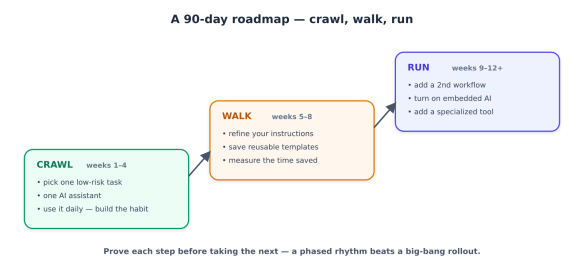
Step 3: Follow a 90-day roadmap, not a big bang
The pace that actually works for small teams is deliberately unglamorous: one workflow at a time, measured before you expand. Rushing produces tool sprawl, blown budgets, and a sceptical team.
Crawl (weeks 1–4): Pick your one task from Step 1. Use a single assistant on it every day until it’s second nature. The goal is a habit and a feel for what the tool is good and bad at — not transformation.
Walk (weeks 5–8): Improve your instructions, save the prompts that work as reusable templates, and measure: how much time is this actually saving? Write the number down.
Run (weeks 9–12+): Add a second workflow. Turn on the embedded AI in your existing software. Consider one specialised tool if a clear pain calls for it. Then repeat the cycle.
Twelve months to get two or three areas of your business running on AI with proper habits and oversight may sound slow amid the hype. It’s the pace that compounds instead of collapsing.
Step 4: Learn the one skill that makes it work — good instructions
Most small businesses get mediocre results for one reason: they give the AI vague instructions. The fix is the highest-leverage skill, and it’s not technical — it’s just being specific and giving context. A weak prompt gets a generic answer; a good one gets something usable. The recipe:
ROLE:    Who the AI should act as.        "You're my café's social media manager."
CONTEXT: Facts about your business.       "We're a family cafe in Leeds known for
                                           sourdough and a relaxed vibe. Casual, warm tone."
TASK:    Exactly what you want.           "Write 5 Instagram captions for this week's
                                           specials, each under 30 words, with a question
                                           to drive comments."
FORMAT:  How you want it back.            "Number them. No emojis in the first two."
Save the instructions that work as templates you reuse — the difference between a business that gets consistent results and one that rerolls the dice every time. (Three-quarters of small businesses have no consistent approach to this, which is exactly why their results feel hit-or-miss.)
The guardrails: how not to get burned
This is the part that protects everything else. AI’s failures aren’t loud — it doesn’t crash, it confidently produces something wrong — so the guardrails are about catching that before it reaches a customer or your bank account.
Verify anything that matters. AI makes mistakes with total confidence — wrong facts, wrong numbers, invented details. Keep a human eye on anything customer-facing or money-related. The rule of thumb: the higher the stakes, the closer you look.
Protect your data. Don’t paste sensitive customer information, financial records, or anything confidential into a consumer AI tool. Use a business/paid account (the data handling is better), read the tool’s data policy, and decide deliberately what’s allowed — before an employee quietly pastes your customer list into a free tool they found online.
Never auto-send high-stakes content. AI can draft a contract clause, a financial summary, or health-related copy — it should never be the final word on them. Those get human sign-off, every time. When in doubt, a professional reviews it.
Keep your voice. Edit drafts so they sound like you, not like generic AI. Customers can increasingly tell, and “obviously AI” erodes the personal touch that’s a small business’s advantage.
Avoid tool sprawl. Every subscription is a cost and a login and a place your data lives. Add tools only when a specific, recurring pain justifies one.
Measure what matters
Finally, track outcomes, not activity. “We use AI now” is not a result. These are:
Time saved per week (the easiest, most immediate win — owners average 5–7 hours).
Revenue and leads — more content shipped, faster quotes, more reviews answered, recovered carts.
If a use case isn’t moving one of these after a fair trial, drop it and try another. That’s not failure; that’s the method working.
The bottom line
AI won’t run your business, and it won’t fix a broken one — it amplifies whatever you point it at. Point it at the right tasks, with good instructions and sensible guardrails, and a small team can market like a bigger one, respond faster than its competitors, and hand the evening paperwork to a tireless assistant. The owners who’ll look back on this year as a turning point aren’t the ones who bought the most tools. They’re the ones who picked one real problem, solved it with AI, measured the win, and built from there. Start there this week.